Key Highlights
- A vibrant office environment requires a balanced noise level, typically between 50-60 decibels, to encourage collaboration and social interaction.
- Different tasks demand specific sound environments: 20-30 dB for deep focus, 30-40 dB for general work, and 50-60 dB for collaborative activities.
- Acoustic treatments like ceiling tiles, baffles, and wood materials effectively reduce unwanted noise and create natural focus zones.
- Decibel measurements provide snapshots of sound levels but should be complemented with understanding of space usage and sound sources for effective acoustical management.
- Strategies to improve office acoustics include reducing noise at the source, managing materials, and establishing designated focus zones for deep work.

Is your office too loud—or is it not loud enough? A certain level of noise—created by a consistent buzz of conversation, the sounds of people typing, or the occasional phone call—can make a space feel alive. But there’s an ideal range the noise needs to fall into, according to research by Ark Research Lab, a subsidiary of HLW. Too much, and your space feels cacophonous; too little and it feels empty and unsettling.
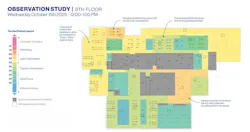
One Ark client, a technology company, wanted to measure the vibrancy of its own office spaces and determine empirically how its environment feels. Ark researchers walked the spaces with decibel meters and recorded volume levels across 10 floors multiple times a day to see how sound levels varied. Here’s what they discovered.
1. You Can Hear a Vibrant Office
Ark’s technology client had an office that was on the quiet side. Like many offices, the client had people working remotely during the early days of the pandemic, then struggled to bring them back into the office as the years went by. Because there weren’t many people in the space making noise, the sound levels weren’t where they needed to be to create a vibrant feeling.
“What they really wanted is to call people back into the office and for those people to feel like there was a reason to come in—that if they came in, it would be a collaborative environment. They’d see their colleagues, and they’d be able to do their work, but there would be other things happening throughout the day that were meaningful and would help them feel tied to the organization,” explained Brian Ledder, HLW Senior Design Strategist and a member of the Ark Research team. “This whole idea of feeling vibrant—that’s what makes the office a meaningful place to be.”
A vibrant office buzzes with energy and activity, Ledder added. “There are people to talk to. You’ll probably be doing your work most of the day, but if you want to get up and grab a cup of coffee, you’ll run into someone along the way and have a conversation,” he said. “A vibrant office is about all of these additional opportunities for collaboration, seeing and hearing the people and work happening around you.”
2. Different Tasks Require Different Noise Levels
A level of 30 to 40 decibels is ideal for focus work, Ledder explained; deep focus may require a lower level between 20 and 30 decibels. Collaborative spaces require more energy and should hit the 50- to 60-decibel range. “Above 60-70 is generally distracting, but it depends on what kind of sound it is,” Ledder explained. “If it’s consistent, your brain can filter it out more easily. If it’s not, it takes more work to focus.”
The team found that in quieter areas, the HVAC system set the noise baseline at about 45 dB, a level still compatible with concentration—especially since the sound of air blowing through ducts is fairly consistent and easy to block out. Add people to a space, and the HVAC system is drowned out by chatter, keyboard noises, and papers shuffling around the 55-dB level. That’s where vibrancy starts, the study revealed.
3. Acoustic Treatments Do Work
“This was one thing that was very clear in our study,” Ledder said. “Acoustic ceiling tiles do really well in terms of mitigating sound, but you can actually go too far with a full ceiling of acoustic ceiling tiles. That might be too much, especially in a post-pandemic office where you don’t have that many people in and there’s not a lot of noise and voices.”
The team found that the noise level was roughly 10 to 20 dB quieter in zones with acoustic ceiling tiles instead of open ceilings. These areas created natural focus zones. Building owners and facility managers who need to lower the noise level can look at acoustic treatments to effectively treat the problem, Ledder said.
“We’ve found that baffles are a good middle ground for controlling the sound to some degree, but not eliminating it like acoustic ceiling tiles do,” Ledder added. “Wood is another great material for that purpose, because it has some sound dampening qualities but it’s not going to totally eliminate it. Think about where the source of noise is coming from—it’s probably going to be spaces that are more active—and think about how to manage that sound.”
How to Study Your Own Noise Levels
The decibel meters used in the study can be helpful, but they also only provide a snapshot of what’s happening in a space, Ledder cautioned: “You walk through, you take a reading, and 10 seconds later it could sound completely different,” he said. “You need to understand how work happens throughout the day and how spaces are used. Maybe you take a couple of snapshots in time, or you come back every hour or every 15 minutes to key spaces you know you want to record.”
Understanding your decibel data requires you to answer a few key questions:
- What type of sound is it?
- Is the sound consistent or intermittent? Is it pleasant or jarring?
- Where is the sound coming from?
- What materials do you have in the space that are either mitigating sound travel or causing it to travel more?
- Who is in each space and what do they need to do their jobs?
An acoustic consultant can give you more insights and a better idea of how to fix spaces that are too loud or too quiet, Ledder added. However, if you need to make changes quickly, there are a few strategies you can pursue that should help:
- Focus on reducing unwanted noise at the source. When you understand where noise is coming from, you can figure out how to bring that level down—or to amplify people chatter, keyboard clatter, and footsteps to even out the overall level so it has fewer peaks and valleys to distract people.
- Understand the materials in your space. People walking on concrete can be distracting, but adding carpet or wood can help even out that sound.
- Create at least one focus zone. Give people a place to go that’s around 20 to 30 decibels. Then, anyone who needs to achieve deep focus work has a destination.
“Generally, what people want is that vibrant office setting. You can be at home in silence,” Ledder said. “When you come into the office, you want something different, and you want people to feel like they’re there for a reason.”
About the Author
 Janelle Penny
Janelle Penny
Editor-in-Chief at BUILDINGS
Janelle Penny has been with BUILDINGS since 2010. She is a two-time FOLIO: Eddie award winner who aims to deliver practical, actionable content for building owners and facilities professionals.