Historic Dallas High School Becomes LEED Gold Office Through Adaptive Reuse and Structural Restoration
Key Highlights
- Adaptive reuse projects are increasingly driven by necessity, transforming vacant or underused buildings into functional spaces to support economic growth and sustainability.
- Restoring historic buildings requires careful structural stabilization, code upgrades, and energy efficiency improvements, often leveraging tax credits and incentives.
- Designing for flexibility and operational security is crucial, especially when repurposing buildings in strategic locations with security considerations.
- Securing funding through historic tax credits, TIF, and preservation compliance is vital for the financial viability of adaptive reuse projects.
- Successful adaptive reuse balances preservation of architectural character with modern performance standards, demonstrating the importance of thorough planning and innovative design.

Project Details
Client
Matthews Southwest and Paradise Development
Location
Dallas, TX
Square Feet
109,000
Services
Architecture, Historical Designation, TIF Funding
LEED Certification
CS v2009 Gold
Adaptive reuse projects have long been considered an inventive approach to boost economic activity within neighborhoods and to support sustainability and historic preservation initiatives. Lately, however, necessity is driving the surge in demand for adaptive reuse, turning vacant office buildings into multifamily housing or dead mall space into houses of worship, for example. In fact, multiple projections estimate that 90% of real estate growth in the next 10 years will involve repositioning existing buildings over new construction, according to Gallagher consulting.
This reality certainly played out in the great state of Texas, where its Old Dallas High School (also known as Crozier Tech) stood as both a civic landmark and a stranded asset. The four-story structure, spanning over 109,000 square feet, had fallen into disrepair and faced an uncertain future as to whether it should be restored or replaced.
“Our owners had looked into the building and decided that it’s a great building, and they did some exploratory surgery on it and walked it,” said Fred Martinez, Associate Principal and Team Leader at Merriman Anderson Architects (MAA), which played a critical role in the project as the architect of record for the building shell and restoration. “They did some renovation renderings of what it could be and sent that across the nation to developers saying, ‘This is what it could be.’”
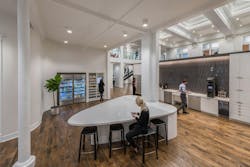
Fortunately, global real estate developer Matthews Southwest agreed that it would be a great anchor point for the city as it had been when it was originally constructed. The client then cast a vision to revive the building as a sustainably designed, speculative office with a potential restaurant or retail component and was elegantly refurbished into a Class A office while preserving its rich history and architectural character.
Old Dallas High School History and Architectural Significance
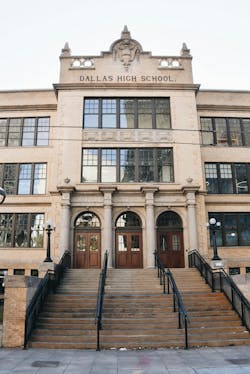
Constructed in 1907 with a rear 1911 addition by Chrisman and Nesbit and designed by the local firm of Lang and Witchell, the architecture is of Classical Revival style and remains largely intact. The principle facade features large Tuscan order columns flanking the elevated main entry, and the rest of the building is largely organized around a central auditorium with intact Corinthian order columns with educational themed motifs. Additionally, the Auditorium and Classroom Building is listed on the National Register of Historic Places and is a City of Dallas Landmark—and in terms of its place on the pop culture map, it was also featured in the 1980s film Robocop.
But time and neglect presented significant challenges to the project team as they assessed the building’s existing conditions.
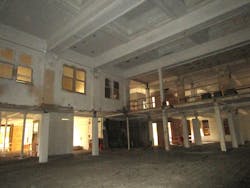
“We pried the doors open, we walked in, and it was not in the best of conditions,” recalled Martinez. “Obviously, people had moved in and used it as a shelter and had been burning things in there—it was not great.”
The two-story auditorium—a central feature within the building—had collapsed and was in shambles. Many of the Corinthian capitals had been broken off and would require plaster molds to replicate the originals, and all of the finishes and cosmetic touches would need to be replaced and redone.
Martinez explained that after thoroughly examining the building’s structure and foundation, which had been dilapidated and ruined from water and exposure, the team knew it faced a long, complicated process of tearing it down to its bare bones and rebuilding it from scratch. In spite of the dire conditions, however, the building’s identity was still very much intact, according to Martinez.
“The entrance is just stellar. When you look at the entrance of the building, it's got that old Renaissance architecture,” he said. “The bones and the look and the feel were still there.”
Structural Stabilization and Code Upgrades for Adaptive Reuse
Stabilizing the building and getting it to code required deep structural work, including drilling new concrete piers in the basement and restoring all floor levels and roof structure. Performance upgrades—particularly at the roof and envelope—had to bring the building closer to today’s efficiency requirements, as well as earn enough points to achieve a LEED Gold rating, which they did.
“There was no R-value to the roof before then,” Martinez explained. “The roof had been basically falling down. It was an old wood frame truss system that had been dilapidated and not protected over the years.”
All of the original ¼-inch single-pane glass windows had to be replaced as well because they were inefficient—and most were already broken. The team’s upgrade strategy aimed to transform the thermal profile in a way that supported long-term operations.
A highly reflective TPO roofing membrane, high-efficiency HVAC systems, and LED lighting were installed to improve energy performance. Low-flow fixtures reduced potable water use by more than 49.31%. In addition, more than 99.64% of the existing core and shell were reused, and recycled-content materials were specified to help minimize construction waste, according to Matthews Southwest.
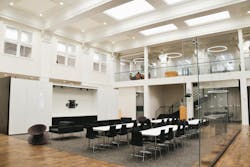
Additionally, the design team discovered a raised flooring deck that had been used to run electrical across the building without tearing up the plaster ceiling. Rather than fight that legacy approach, MAA leaned into it by recreating a more efficient raised flooring system while preserving all of the original wood floors on top of it.
Finally, the project team also had to account for contemporary realities beyond energy performance, such as access control, tenant safety, and the lived experience of entering and moving through a repurposed building. The site had obvious benefits and was set up for success, Martinez said, but it also introduced operational concerns.
“It had potential because of its location right there on the DART, but that also made it a liability because of security,” he observed. The security and arrival strategy moved to the forefront of the design conversation, rather than as an afterthought. As a result, the team added a back booth check-in station which is the main check-in point for security that supports day-to-day operations while enabling the flexibility the owners wanted.
Financing Adaptive Reuse: Tax Credits, TIF, and Preservation Compliance
The design of Old Dallas High School was aimed at meeting the criteria for State of Texas and Federal Historic Tax Credits, which involved meticulous planning and attention to detail. Additionally, MAA supported the Texas Historical Commission (THC) and National Park Service (NPS) application process and helped obtain Tax Increment Financing (TIF) and Landmark Commission approval from the City of Dallas, making this project a truly successful one.
“The historic tax credits, obviously the TIF funding from the city, was incredible and that really made the project happen,” Martinez said.
Due to the massive costs involved with the structural repairs, the design team knew the tax credits would not cover them. (Federal and state historic tax credits provided $14.5 million of the total $52 million project cost.) So, it worked very closely with NPS on the areas where it could restore things like bricks, cast stone, or ornaments rather than tearing them down and redoing them from scratch. The lengthy and arduous process paid off, however, and “that’s what got us to the final goal line,” Martinez said.
In the end, the Old Dallas High School project stands as proof that a building can be both historically grounded and operationally credible if the team is willing to do the challenging work that adaptive reuse requires.
For Martinez, the result is personal: “It’s one of my pride and joys. It’s my favorite project I’ve ever worked on in my career,” he said. “It’s a project that I’ve always loved looking at it, and I still admire it for its character and its age and its longevity.”
Adaptive Reuse Owner Takeaways
- Budget for unknowns and investigative work early.
- Align with historic reviewers early; test methods before committing.
- Design flexibility into ground floors and core planning.
- Treat envelope upgrades as lifecycle investments (not “nice-to-haves”).
- Build a financing strategy that leverages credits/incentives where applicable.
About the Author
 Robert Nieminen