How HVLS Fans Work with HVAC Systems to Improve Building Efficiency
Key Highlights
- HVAC systems account for about 35% of energy use in buildings, with outdated infrastructure contributing to inefficiency.
- Large facilities face airflow challenges like temperature stratification and uneven air distribution, impacting comfort and energy consumption.
- Implementing energy recovery ventilators and repositioning dampers can improve airflow and reduce energy waste.
- HVLS fans provide broad, low-speed airflow that destratifies warm and cool air, enhancing comfort and reducing HVAC workload.
- Upgrading HVAC systems and integrating airflow solutions can lead to energy savings of up to 15% and improved building performance.
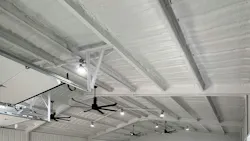
HVAC systems account for one of the largest energy expenses in commercial and industrial buildings, especially in facilities where maintaining consistent temperatures is challenging.
Improving air circulation can significantly enhance HVAC performance. When air is distributed more evenly throughout a space, HVAC systems can maintain desired temperatures more efficiently. Airflow improvement systems play an important role in helping facilities manage airflow while supporting efficient HVAC operation.
HVAC Systems: The Hidden Energy Drain
According to the Department of Energy, the energy used for heating and cooling buildings accounts for about 35% of all energy consumption in America, the largest share of any end use. This is particularly significant for facilities that operate year-round or require strict temperature control.
One reason HVAC systems consume so much energy is the age of existing infrastructure. Many buildings still rely on their original HVAC systems, designed under different efficiency standards. Legacy equipment typically uses less-efficient motors, outdated controls, and ductwork that may not be optimized for modern building layouts.
Most existing HVAC systems are oversized for the space to meet the most extreme temperature loads, says the Department of Energy. Oversized HVAC equipment reduces efficiency, strains the system to produce, increases wear on equipment, increases humidity during the summer months, and leads to frequent maintenance, repair, or replacement costs.
Air Distribution Challenges in Large Facilities
In large facilities, the substantial volume of air that must be heated or cooled is a major contributor to overall energy use. Buildings with higher ceilings contain massive air volumes. Equally distributing that air requires significant energy use. When airflow is not properly managed, HVAC systems may need to operate longer or work harder to maintain comfortable conditions. In addition, structural elements and large equipment obstruct airflow patterns. These obstacles create pockets where air movement is limited, resulting in areas that may feel significantly warmer or cooler than others.
Some facility types that may face greater challenges with proper airflow are:
- Hospitals
- Manufacturing facilities
- Gyms
- Schools
The Problem of Temperature Stratification
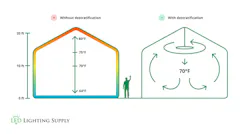
Temperature stratification is one of the most common airflow challenges large facilities face. Stratification occurs when air in a space separates into uneven layers, creating non-uniform airflow. In buildings with high ceilings, this effect can become significant. During heating seasons, warm air generated by the HVAC system rises quickly. Meanwhile, the occupied zone near the floor may remain noticeably cooler. In turn, HVAC systems operate over time to change the temperature.
Without adequate circulation, airflow may not be evenly distributed throughout the building. This can lead to hot spots, uncomfortable working conditions, humidity buildup, and increased energy demand as systems attempt to compensate.
Strategies to Improve HVAC Airflow
There are several strategies facility managers utilize to help improve airflow in a facility.
A common solution is to implement ventilation systems with Energy Recovery Ventilator (ERV) functions. The Department of Energy defines ERV functions as techniques that transfer energy between the outdoor supply air and the exhaust air streams, preventing the ventilation system from wasting energy.
EVR examples involve various methods that alter an HVAC system to improve airflow. It can be as simple as manually repositioning the dampers or adding energy-saving devices, such as Energy Recovery Wheels. With these solutions, systems waste less energy by improving the airflow in the building. Most dated and original facility HVAC systems lack these solutions. As a result, the space’s HVAC system uses more energy to reheat or cool the fresh air brought in from outside.
While approaches like this can improve HVAC efficiency, they may require significant upgrades and modifications to the system. In many cases, improving air circulation within the building can effectively enhance overall HVAC performance.
Where HVLS Fans Fit In
High volume, low speed (HVLS) fans are designed to move large amounts of air at relatively low rotational speeds. Unlike smaller commercial fans that produce narrow streams of airflow, HVLS fans generate broad air movement that can cover large areas. In facilities with high ceilings and open floor layouts, HVLS fans help improve overall air circulation. By maintaining constant airflow throughout the facility, these fans blend warm and cool air evenly across the space. This process, known as destratification, helps reduce temperature inconsistencies in the building. During heating seasons, mixing warm and cool air allows HVAC systems to maintain comfort levels more efficiently.
Rather than replacing or renovating HVAC systems, HVLS fans support the system by improving airflow throughout the building. Integrating these fans with existing HVAC systems reduces system strain, lowers heating and cooling costs, and improves energy efficiency by up to 15%.
HVAC systems remain the key to maintaining building temperatures, but their effectiveness is closely tied to how well air moves throughout the space. In facilities with common airflow challenges, improving air circulation helps HVAC systems distribute air more evenly. Solutions like HVLS fans help facility operators improve comfort while supporting more efficient HVAC operation.
About the Author
Brianna Sapienza
Brianna Sapienza is a Content Marketer at LED Lighting Supply with over four years of experience creating educational content for the industrial sector. As an expert in content strategy, she creates practical, jargon-free resources that simplify complex topics in lighting, fans, and poles. When she's not writing, Brianna enjoys reading, staying active, traveling, and spending time with family.