Optimize Before You Replace: A Practical Framework for Evaluating Cooling System Performance
Key Highlights
- Adding specialized heat transfer fluid additives can improve system efficiency by 10-15% without replacing equipment or causing downtime.
- Establishing a performance baseline and requiring a formal measurement and verification plan are critical steps before considering system upgrades.
- Operational risk assessment helps determine whether modifications can be made without system shutdowns, reducing financial and operational impacts.
- Installing variable-frequency drives (VFDs) on pumps and fans offers high returns by matching system output to actual load demands.
- Regular water quality management and chilled-water reset strategies can prevent fouling, improve heat transfer, and enhance overall system performance.
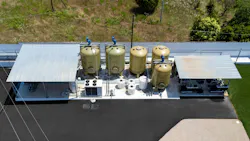
When a cooling system starts underperforming, the instinct is often to replace it. That instinct is expensive—and frequently wrong. Before committing to capital replacement, building owners and facility managers have more options than they may realize, and a clear framework for evaluating those options can save significant time, money, and operational disruption.
Field Experience Shows Fluid Quality and Capacity Matters
Cooling systems can account for up to 40% of a building's total energy consumption, according to the U.S. Department of Energy. And closed-loop hydronic networks typically lose 1-3% of efficiency per year through fouling, scaling, and fluid degradation—a compounding loss that often goes undetected until a system can no longer meet load.
In our company’s field experience, adding specialized heat transfer fluid additives to existing chilled water and glycol loops—enhancing the thermal capacity of the fluid itself without replacing any equipment—has consistently delivered whole-system efficiency gains of 10-15%, verified under the International Performance Measurement and Verification Protocol (IPMVP). Three examples:
- At a major technology campus operating near its utility power limits, hydronic loop optimization delivered a 13% improvement in system efficiency—freeing electrical capacity that was reallocated to IT expansion without new utility service.
- At a metro station chiller plant in the Gulf region, verified efficiency improvements produced 5.9 million kWh in annual energy savings and avoided 3,559 metric tons of CO2—equivalent to removing roughly 800 cars from the road each year.
- At a 1-million-square-foot logistics warehouse, improved loop performance delivered a 12% gain in chiller efficiency, reduced compressor runtime, and stabilized zone temperatures across the facility.
In each case, improvements were achieved without equipment replacement and without system downtime.
A Four-Step Framework Before You Commit Capital
Before signing off on a replacement project, work through these four steps:
- Establish a system performance baseline. Analyze energy efficiency data from comparable facilities—similar size, construction type, and equipment configuration. Key metrics to track: Coefficient of Performance (COP) for chiller systems, pump energy relative to flow rates, delta-T across heat exchangers, and peak-period power draw. If your team doesn't already have these numbers, that gap is itself useful information. You cannot evaluate a performance problem you haven't measured.
- Require a Measurement and Verification Plan. Before committing to any retrofit strategy, ask vendors for a formal M&V plan that specifies baseline protocols, data collection points, a methodology for isolating the intervention's impact from seasonal variation, and a 12-month monitoring period. The widely accepted standard is the International Performance Measurement and Verification Protocol (IPMVP), maintained by the Efficiency Valuation Organization (evo-world.org). If a vendor can't provide this, that is a red flag.
- Evaluate operational risk. Ask whether the modification or retrofit requires downtime, equipment modification, or BMS changes. For hospitals, data centers, and logistics operations, even brief interruptions carry real financial consequences. Interventions that work within existing infrastructure—no shutdown, no equipment swap—carry significantly lower risk than replacement. Factor that risk differential into the economics, not just the capital line.
- Model the economics—not just the payback period. Payback period is the starting point, not the conclusion. Also model return on investment over the full useful life of the intervention, the capital expenditure avoided by deferring replacement, and any applicable utility incentives or rebates. Well-executed hydronic system optimizations typically return payback in two to three years. A retrofit that defers replacement by even three to five years can be worth more than the efficiency gain alone.
Practical Priorities You Can Act on Now
Regardless of where you land on the optimization-versus-replacement question, several maintenance and operational decisions consistently separate high-performing buildings from average ones:
- Install variable-frequency drives (VFDs) on pumps and fans if you haven't already. VFDs allow systems to match output to actual load rather than running at fixed capacity. They typically deliver rapid payback and are one of the highest-return retrofit decisions available.
- Evaluate heat transfer fluid additives for your closed-loop systems. Specialized additives that enhance the thermal conductivity of existing chilled water or glycol loops can improve heat exchanger performance, reduce compressor workload and recover meaningful capacity—without equipment replacement, system modification, or downtime. Fluid additives are one of the few retrofit-ready interventions that work within the physics of existing infrastructure rather than around it. When evaluating options, require independent M&V verification and a track record across system types similar to yours.
- Audit your water quality management. System filtration, chemical balance, and regular treatment prevent the fouling and scaling that silently degrade heat-transfer efficiency and shorten equipment life. If your service agreement doesn't tie maintenance tasks to specific performance outcomes—rather than generic checklists—renegotiate it.
- Use chilled-water reset strategies in your BMS. Allowing warmer chilled-water supply temperatures during lower-load periods improves chiller operating efficiency with no additional capital cost. If your building management system supports it and you're not using it, you're leaving savings on the table.
- Track delta-T and approach temperature on a regular schedule. These metrics tell you how effectively your heat exchangers are performing. A narrowing delta-T is an early warning sign of fouling or capacity degradation—caught early, it's a maintenance issue; caught late, it becomes a capital conversation.
A Note on Electrification
If your building is subject to Local Law 97 in New York City—or similar mandates pushing toward heat-pump systems—be aware that legacy coils designed for 180-200 degrees F. hot-water supply may struggle with the 120- to 160-degree output from heat-pump loops. Replacing coils or upsizing pumps to compensate is invasive and expensive. Improving heat-transfer performance within the existing hydronic loop can bridge that gap, helping buildings meet comfort and compliance targets without major mechanical changes.
The Bottom Line
Replacement is sometimes the right answer, but it should be the conclusion of a rigorous evaluation—not the default response to underperformance. Establish your baseline, require measurement and verification, assess operational risk, and model the full economics. The building owners who do this work consistently make better capital decisions and get more life from the infrastructure they already own.
About the Author
Ben Taylor
Ben Taylor is Vice President of HT Materials Science, leading North American business development and product applications for solutions such as Maxwell®, the company's heat transfer fluid additive for closed-loop hydronic HVAC systems. A mechanical engineer (B.S., Clemson University), he spent six years as a sales engineer with Trane before joining HTMS. He is an active member of ASHRAE. HTMS has deployed Maxwell® across more than 50 sites globally and was recognized as a BloombergNEF 2026 Pioneer and named to the Cleantech 100 for its work in energy efficiency innovation.