Wells Fargo Drives Innovation with America’s Largest Net-Positive Campus
Key Highlights
- The campus is the largest net-positive corporate site in the U.S., generating more energy than it consumes through solar panels and efficient design.
- Passive design strategies, including high-performance envelopes and dynamic glass, significantly reduce reliance on mechanical heating and cooling, even in Texas’ tough climate.
- Smart energy management and operational strategies optimize energy use, with occupancy-based controls and continuous data-driven adjustments enhancing efficiency.
- Green initiatives include water reclamation, greywater reuse, native landscaping, and stormwater harvesting, reducing potable water use by over 58%.
- The campus prioritizes employee well-being with sunlit workspaces, flexible areas, wellness facilities, and outdoor green spaces that foster collaboration and connection.
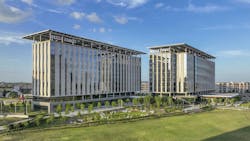
Wells Fargo’s new campus in North Texas is redefining what a corporate workplace can be.
Located in Irving’s Las Colinas neighborhood, just northwest of Dallas, the financial giant’s goal was bold: build a high-performance workplace for 4,500 employees that doesn’t just reduce its environmental impact but actually generates more energy than it uses.
The result is a groundbreaking campus, which opened in October 2025, that reimagines sustainable and community-focused corporate environments and raises the bar for what’s possible.
Spanning 22 acres along Lake Carolyn, the site features two sleek 10-story office towers and a six-level parking garage, totaling 850,000 square feet. Backed by a $570 million investment and strong partnerships between Wells Fargo, Corgan, KDC Real Estate Development & Investments, and Austin Commercial, it’s the largest net-positive corporate campus in the U.S., designed to benefit both people and the environment.
This is the first net-positive project for both Wells Fargo and Corgan, marking an important step forward in sustainable corporate design.
Passive Design is the Backbone of Sustainability
Passive design is at the heart of the campus’ sustainability. By using strategies that make the most of natural light and temperature control, the campus cuts back on the need for mechanical heating and cooling—even with Texas’ tough climate.
“The more we can manage the energy flow through the building’s envelope, the more efficient we become,” said Varun Kohli, director of sustainability at Corgan.
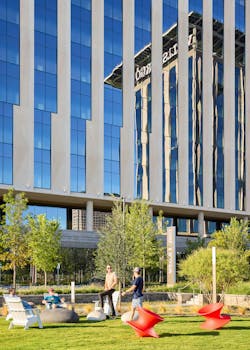
To help protect against the intense Texas sun, the campus features a high-performance envelope with tinted glass windows. While the upfront cost was considerable, Kohli said the long-term gains in comfort and energy savings make it well worth the investment.
The towers are positioned to let in plenty of natural light while reducing glare. The team used special “dynamic glass” that automatically adapts to keep the inside bright but comfortable. Features like the window-to-wall ratios and shaded terraces help the buildings rely less on heating and cooling.
The buildings’ outer shell keeps out the intense Texas sun. With low-carbon concrete and advanced ventilation, the interiors remain comfortable and energy-efficient. Thanks to these features, the campus is on track to earn LEED Platinum certification. According to Kohli, energy use averages just 36 kBtu per square foot, an impressive efficiency for a campus of this size in Texas.
Active Technologies and Operational Strategy
While passive strategies set the foundation, cutting-edge, active technologies push the campus’ performance even higher. Solar panels stretch across 360,000 square feet of rooftops and garages, generating about 9.45 million kilowatt-hours annually, roughly 5% more than the campus requires. This surplus energy is delivered back to the local community grid.
Smart energy management systems constantly monitor and adjust lighting, HVAC, and other building systems in real time, responding to occupancy and weather. Rather than treating energy modeling as a one-time step, the team made it an ongoing process, updating decisions with new data to make sure the campus adapts to real use.
“Often energy modeling is treated as sort of an end-of-the-project component rather than a reiterative process,” explained Kohli. “We were using that information to feed back into the design so that we were responding to the loads.”
Additionally, Kohli said how a building operates is just as critical as its design and construction. “We can design a building to be as efficient as possible, and the construction team can deliver on those standards, but in the end, how it’s run will determine if we meet our energy goals,” he explained.
Efficiency only happens when operations align with design. By grouping departments that share similar working hours, whole sections of the campus can be shut down when not needed, which is something many conventional designs overlook.
“It's this hidden piece, almost a non-architecture [element] that for me was the most fascinating, and that was this collaborative understanding of how to actually use the building,” explained Kohli, adding that they worked closely with Wells Fargo’s facilities management teams.
This collaboration led to innovative ways to save energy. “We analyzed how the building would be used and found that occupancy patterns and operating schedules had the greatest impact on overall energy use,” noted Garry Walling, Corgan principal and studio design director.
“Departments that might operate 24/7 were placed together rather than being spread throughout both buildings,” Walling continued. “This allowed some floors to remain fully operational around the clock, while other areas of the campus could power down during off-hours, significantly reducing energy use.”
Other smart features include high-efficiency HVAC, water reclamation systems, and intelligent controls that adapt to occupancy, all working together to minimize waste and maximize performance.
Employee Experience and Community Engagement
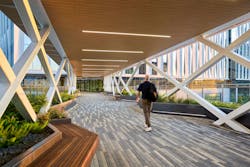
The campus does more than meet sustainability goals; it’s designed to boost employee experience and well-being. Sunlit spaces, flexible work areas, and inviting meeting hubs spark collaboration, creativity, and connection. Fitness centers, healthy dining options, walking trails, and wellness rooms help attract and retain top talent for today’s hybrid workforce.
Every detail is built around employees. “At the end of the day, we design for people,” said Kohli.
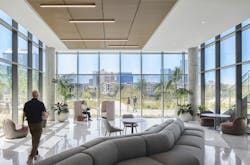
“From an experience standpoint, access to light was important,” Walling explained, pointing to the bright lobby and open workstations with views of Lake Carolyn and the Dallas skyline. Employees can choose how and where they work, whether in quiet focus rooms or lively, sunlit areas. Social spaces like coffee bars and kitchens encourage casual connection. “It’s about giving people options,” Walling added.
Water and Green Space
Sustainability here goes beyond energy use, as innovative water management and large green spaces are central to the campus. Greywater collection and smart irrigation, using water from Lake Carolyn, reduce the need for local potable water.
Native landscaping, stormwater harvesting, and advanced irrigation systems cut potable water use for landscaping by 58%. Inside, greywater reuse meets 74% of water demand, while high-efficiency chillers improve performance by 35%.
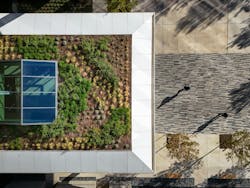
More than a third of the campus is dedicated to green space, supporting biodiversity and creating restorative areas for employees. Outdoor gathering spots, walking paths, and shaded seating connect people with nature and each other.
Wells Fargo’s campus revolutionizes the concept of the modern workplace, combining sustainable strategies, cutting-edge technology, and a people-first design to show that corporate spaces can give back more than they take.
How This Project Came Together
Wells Fargo’s new North Texas campus uses these products and materials:
Interior
- Acoustic Panels – Armstrong, Carnegie
- Carpet – Tarkett, Interface, Mohawk
- LVT – Milliken
- Rugs – Mohawk, Rug Company
- Solid Surface – Caesarstone
- Laminate – Wilsonart
- Paint – Benjamin Moore, Sherwin Williams, Scuffmaster
- Resin Panel – 3form
- Tile – Daltile, Stone Source, American Terrazzo
- Upholstery – Carnegie, Momentum, Edelman, Maharam
- Wall Covering – Westfall & Kitson, Momentum, Aesthetics, Mitchell Black
- Ceilings – Arktura, Armstrong
Exterior
- Architectural Precast Concrete – Redondo Manufacturing
- ACM panel – Mitsubishi Alpolic
- Composite Wood Soffit Panel – Trespa Pura
- Glazed Aluminum Curtain Walls – Momentum MG 825 Unitized System and Kawneer Clearwall
- Exterior Glass Glazing – Harmoney Bright Silver by SageGlass
- Photovoltaics – VSUN Solar
- SBS Modified Bituminous Membrane Roofing – Soprema
About the Author
Liz Wolf
Liz Wolf is a Twin Cities, Minnesota-based freelance business writer specializing in commercial real estate.