New Uvalde School Rooted in Trauma-Informed Design
Key Highlights
- The school incorporates trauma-informed principles to lower stress levels and create a welcoming environment through community-driven design and vibrant color palettes inspired by local culture.
- Security features are discreetly integrated using impact-resistant glazing and strategic layout choices, balancing safety with openness and natural light.
- Layered security includes staff training and technology, emphasizing that people are the first line of defense in maintaining school safety.
- A central courtyard and memorial tree serve as community focal points, fostering healing and connection among students and staff.
- Design strategies prioritize flexibility, transparency, and cultural expression to support both safety and a positive learning atmosphere.
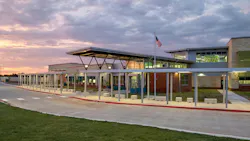
School security discussions tend to focus on hardening strategies through defensive architecture. But an overlooked question is what does a safe school feel like? This was the starting point for the new Legacy Elementary School in Uvalde, Texas. Learn how trauma-informed design principles honor this community’s vision of moving from a painful past into a bright future.
Community Inspiration
Housing grades 3-5, Legacy Elementary offers 116,000 square feet for upwards of 800 students. The new facility replaces Robb Elementary, which was the site of a 2022 mass shooting. The team at Huckabee Architects, now a MOREgroup brand, started the design process with sensitivity and transparency.
Trauma-informed design specifically seeks to “lower the stress levels of students and staff” through intentional environmental cues, according to the nonprofit Uvalde Moving Forward Foundation. A vision for the school took shape through a series of charettes, public meetings, school walkthroughs, interactive diagraming, and separate sessions with families of survivors and victims.
“We listened to the community about how they ultimately wanted the building to be welcoming,” said Mike Hall, director of design for Huckabee’s education division. “They were also clear that the school should represent the vibrant culture and natural region of Uvalde.”
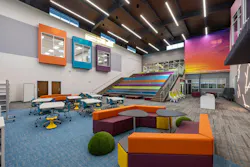
A colorful palette was drawn from the area’s luminous sunsets, Hispanic festivals, monarch migration, honeybee population, and the Frio River. Ranging from teal and lime green to shades of tangerine and magenta, these playful tones ensure the design doesn’t stray into an institutional look.
Especially for a community dealing with collective grief, it’s critical to have security features that unobtrusively offer reinforcement. Avoiding conspicuous reinforcement satisfies principles for both Crime Prevention Through Environmental Design (CPTED) as well as trauma-informed design.
“One of the biggest challenges is creating a secure space that’s inviting, flexible, and conducive to learning,” said Andreea Papas, vice president of marketing at Oldcastle BuildingEnvelope (OBE), which provided Legacy with a suite of forced-entry resistant solutions. “People don’t need constant reminders of what the school has gone through. Robust systems can be strategically integrated so they are indistinguishable from any other architectural feature.”
Seamless Security
Layered security is one of the best defenses against a breach. Yet obvious elements can create a fortress-like atmosphere that is counterproductive to a learning environment.
“The challenge becomes how to not overfortify for an incident, that while low in probability, would dramatically alter the true essence of a school,” emphasized Dr. Kenneth S. Trump, president of National School Safety and Security Services. “It ultimately comes down to risk reduction, not elimination.”
For example, Huckabee paired the visitor’s entrance with a conference room, seating area and restrooms. Locating these amenities at the front limits how far a guest needs to access the interior.
Glass was another key consideration, especially since it’s necessary for sightlines as well as beneficial for educational outcomes. Yet windows and partitions shouldn’t create a feeling of sitting in a fishbowl or undermine lockdown procedures.
“Glazing is a nice solution for this concern,” according to Papas. “It’s transparent to allow natural light in but can also be secured with laminates that aren’t noticeable.”
Reinforced glass should also be paired with a framing system that is tested to withstand impacts. Look for glazing and framing standards that address forced entry and active shooter scenarios, such as ASTM E2395 and F1233.
“Keep in mind that there are some nuances within testing methods. Some are mechanical for impact resistance while others measure time to failure,” Papas explained. “It’s also worth noting bullet resistant is separate from force resistant. Make sure you are comparing apples to apples when evaluating products.”
Dr. Trump cautions that security features and emergency policies must be supported by thorough training. Even a safeguard like a door alarm will fall short if no one is monitoring it or security camera footage isn’t easy to review.
“School safety comes down to people. The first and best line of defense is a well-trained and alert staff and student body,” Dr. Trump stressed. “It’s not just the fortification of the front door or having the latest bells and whistles for physical security—it’s what’s inside that creates a safe and supportive school.”
Hopeful Design
To keep children centered in the space, the school incorporates many cheerful touches. Every corner exudes an energetic atmosphere with plentiful murals, inspiring graphics, and funky furniture.
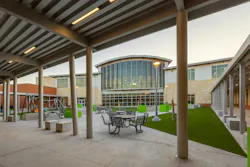
Special attention was paid to outdoor circulation. Rather than placing exterior paths on the perimeter, they are clustered around an interior courtyard. The school’s academic, administrative, and social wings radiate out from this central focal point. The envelope cocoons students as they move between zones while creating this interactive space for laughter.
“It’s basically a little town square oriented toward the library. There’s playground equipment, seating, and planter boxes growing trees,” Hall explained. “One of the most rewarding things at the soft opening was watching how the kids were immediately comfortable transitioning to this new space.”
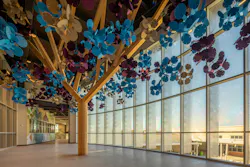
A poignant feature is the memorial tree, which draws inspiration from Uvalde’s heritage oaks and Annie Robb, a teacher who championed for their preservation and is the namesake of the previous school.
“The memorial tree stands as a testament to those who perished, with the two main branches to represent the teachers and 19 branches for the children,” Hall said. “The leaves are made from an acoustic material, which add a sensory element because they move and rustle. The nearby glass is also etched with a biophilic pattern, casting fractal light in the late afternoon.”
About the Author
Jennie M. Morton
Jennie M. Morton is a freelance writer specializing in commercial architecture, building engineering, and sustainable design.