How Alternative Water Sources Like Rainwater and HVAC Condensate Reduce Risk for Facility Managers
Key Highlights
- On-site water reuse reduces dependence on stressed municipal water systems.
- Facilities with consistent non-potable demand benefit most operationally.
- Water reuse supports continuity during shortages and infrastructure failures.
- Treating water as risk reshapes long-term facility planning.

Rainwater and HVAC condensate have traditionally been treated as optional sustainability add-ons in building design; that mindset no longer aligns with today’s operational realities. As climate volatility, aging infrastructure, and water regulations increase pressure on municipal systems, facility managers must reconsider how buildings source, manage, and protect their water supply.
On-site rainwater and HVAC condensate reuse systems offer building owners and facility managers an opportunity to reduce potable water dependence while improving resilience, operational continuity, and long-term cost control. These alternative water sources are being integrated as core infrastructure, particularly in facilities with consistent non-potable demand and heightened exposure to water shortage, restrictions, or service disruptions.

When Potable Water Becomes an Operational Risk
Chief Commercial Officer Eric Hough at Epic Cleantec, a water reuse technology company based in San Francisco, explained how the long-standing assumption that potable water is and will remain inexpensive, readily available, and dependable is no longer true. Add in plumbing and water regulations designed for centralized infrastructure models, making rainwater and HVAC condensate alternative sources with long-overdue implementation.
“For decades, it was simpler to rely entirely on centralized water systems than it was to design for alternative sources,” Hough said. “Since rainwater and HVAC condensate don’t fit neatly into that centralized framework, they were treated as optional sustainability features rather than core building systems.”
Buildings have multiple on-site non-potable water reuse systems that can be used for non-drinking water purposes, such as toilet flushing, clothes washing, cooling tower make-up, and ornamental plant irrigation. From an owner and facility manager standpoint, Hough said, “buildings with large, consistent non-potable demand are best positioned to benefit from rainwater and HVAC condensate capture.”
Building types include:
- Commercial office and mixed-use buildings with significant restroom and cooling loads
- Multifamily buildings, where toilet flushing represents a major share of water use
- Higher education and campus environments, with large roof areas, irrigation needs, and centralized operations
- Healthcare facilities, where continuity of operations and resilience planning are critical
“In each case, the strongest candidates are owners who recognize water not just as a utility, but as a long-term operational and financial risk,” he added.
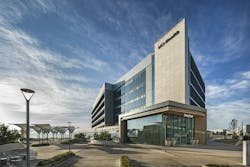
Why On-site Rainwater and Condensate Reuse Systems Reduce System Pressure
Municipal water systems and aging infrastructure are under increasing strain. The built environment can reduce some of the system pressure through rainwater and HVAC condensate capture.
“On-site rainwater and condensate reuse systems reduce demand for highly treated potable water, easing pressure on overburdened treatment plants, pipes, and distribution systems, especially during peak demand periods such as during heat waves and droughts,” Hough said.
These resources also offer health and safety benefits for the end user. Hough noted that the systems match treatment to the intended non-potable end use, so toilet flushing and cooling meet or exceed regulatory requirements. Cities can stretch limited potable supplies with modern treatment, monitoring, and controls that ensure consistent water quality.
In situations of shortages or infrastructure disruptions, reclaiming water and HVAC condensate helps buildings maintain operations independent of municipalities. These systems provide facility managers autonomy over their buildings, maintaining operational status for occupants.
“During water shortages or restrictions, buildings can continue supporting essential functions such as restrooms, cooling, and irrigation, without drawing water exclusively from potable supplies,” Hough said. “During infrastructure disruptions, stored alternative water provides a buffer that helps maintain building operations while centralized systems recover. Instead of reacting to water stress, buildings gain the ability to plan for it.”
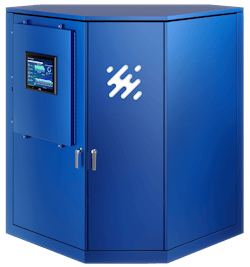
Recovering Water That Buildings Already Pay For
Epic Cleantec’s OneWater Rain system captures both rainwater and HVAC condensate, offering a reliable, year-round alternative source of water for buildings.
“Rainwater can be abundant but is often intermittent and seasonal. HVAC condensate, by contrast, is often produced most consistently during hot periods, precisely when cooling demand and water stress are at their highest,” Hough explained. “Condensate is also typically very clean water that is otherwise simply not captured and sent straight to the sewer. By combining these sources, buildings reduce variability, optimize storage, and make better use of water that has been historically treated as waste.”
As warm, humid air crosses over the evaporator coils of the air conditioning unit, the cool air condenses water vapor into liquid form, which collects in a drain pan below the coil before exiting through a condensate drain line. In a 2013 article, Bernie Daily, president and practitioner of Daily Operations Inc., shared that each gallon of lost condensate can cost $3-4.
“Condensate loss is a compounded loss. You paid for the water to come in and paid for it to leave, even though it left as a vapor,” Daily said. “You also paid for the heat to put it into the boiler the first time, you paid the heat losses when it was delivered, and you lost the heat that you could have returned to the boiler when you lost the condensate.”
Building owners and facility managers who treat rainwater and HVAC condensate sources as core infrastructure are taking a practical step toward resiliency.

Designing Healthcare Facilities for Long-Term Performance
According to the Commonwealth Fund, hospital care accounts for more than a third of carbon emissions in the health system at 36%. Adding to the environmental burden, U.S. healthcare facilities are responsible for 8.5% of the country’s total emissions. The healthcare system is polluting more with increased emissions by 6% from 2010 to 2018, per Health Affairs.
Builders, planners, and facilities managers can curb those emissions with thoughtful planning. Take, for instance, the University of California Irvine Health System (UCI Health) in Orange County.
UCI Health opened a new 350,000-square-foot facility in December 2025. As the country’s largest all-electric hospital, it eliminates on-site fossil fuel combustion for heating, hot water, clinical spaces, and food service. UCI Health offers a new blueprint for resilient, low-carbon care within the healthcare environment, demonstrating how leveraging nearby and renewable resources can constructively impact the environment and the budget.
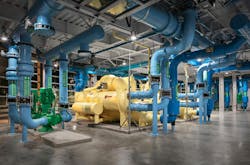
The project features California-native landscaping and integrated stormwater management basins that capture rainwater before filtering through biofiltration using plantings and riprap and releasing it to the adjacent San Joaquin Marsh Reserve.
“We are utilizing the fact that we are directly adjacent to a marshland, and working closely with UCI Nature, we’ve found that the marsh really needs that water,” said Paul Da Veiga, director of planning, design, and construction. “It was a collaborative approach to ensure the water is of good quality as it gets released into the marsh from the site.”
The 100% renewable electric hospital eliminates a major source of on-site emissions through the burning of fossil fuels in boilers and combined heat and power (CHP) systems to operate conditioning, sterilization, laundry, and other essential services. The site combines on-site solar with sustainably sourced grid power. The solar arrays atop parking structures supply 10% of the hospital’s 2 MW daily load.
The hospital’s all-glass facade maximizes natural daylight into the building and reduces solar heat gain and glare as well as energy usage for lighting. Other key design features include a highly efficient building envelope that reduces heating and cooling loads, Energy Star-certified equipment installed throughout the facility, multiple diesel backup generators that provide up to 96 hours of islanded power, and N+2-style redundancy with three primary systems capable of sustaining hospital operations.
Joe Brothman, facilities and general services director at UCI Health, explained that a reliability-centered maintenance program is vital for preserving systems.
“Having a reliability-centered maintenance program where you’re intervening on a maintenance schedule and anticipating potential outages before that, looking at the history of equipment and ensuring that those parts, boards, belts, and things that have to be replaced are done prior to them failing,” he said. “A reliability-centered maintenance program is what healthcare institutions should be working towards because that is more resilient than a preventative maintenance schedule.”
UCI’s future-ready infrastructure is designed to accommodate battery storage, peak load management, and nearby 20-MW microgrid integration to enhance the building’s long-term resilience.
Next Steps
About the Author
 Lauren Brant
Lauren Brant
Buildings Editor
Lauren Brant is the editor of Buildings. She is an award-winning editor and reporter whose work appeared in daily and weekly newspapers. She strives to create content that is informative and actionable for professionals, helping them discover new products, technology, and insights to make smarter building decisions. In 2020, the weekly newspaper won the Rhoades Family Weekly Print Sweepstakes—the division winner across the state's weekly newspapers. Lauren was also awarded the top feature photo across Class A papers. She holds a B.A. in journalism and media communications from Colorado State University-Fort Collins and a M.S. in organizational management from Chadron State College.