Beyond Efficiency: Energy Savings Are Just the Start with PCM Ceilings
Key Highlights
- PCM ceilings passively regulate room temperature by absorbing and releasing heat, reducing reliance on HVAC systems and lowering energy costs.
- They support sustainability goals by being domestically produced, BABA compliant, and free of Red List chemicals, enhancing indoor environmental quality.
- Installation is straightforward with standard sizes and lightweight panels, facilitating retrofits and new builds while supporting energy modeling and tax incentives.
- PCM ceilings improve acoustic performance, contributing to better indoor environmental quality and occupant comfort.
- Incorporating PCM technology can lead to significant financial savings through energy efficiency, reduced peak temperatures, and eligibility for federal tax credits.
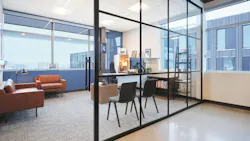
When phase change material (PCM) was first integrated into acoustical ceiling panels, the big headline was the energy savings potential and with good reason. The innovation stood to provide building owners and facility managers with answers to some of their most urgent energy-related questions:
- Where can I reduce energy expenditures, or at least level out costs during price volatility?
- Is it possible to reduce OpEx without a large investment in a new HVAC system?
- How can I accurately forecast energy budgets amid the unseasonable, unpredictable extreme heat and cold driven by climate change?
- How do I show stakeholders we are mobilized in our environmental commitments?
A little over two years ago ceiling panels with PCM became available for new commercial building projects and renovations. While these ceilings’ contribution to energy savings remains a key benefit, it now shares the spotlight with a host of other advantages ranging from improved thermal comfort to financial incentives. Some of these have “always been there” and some have evolved since the first iteration of ceiling panels with PCM. The upshot is that, whether it’s a brand-new hospital, the retrofit of a small community clubhouse, or anywhere in between, building owners and facility managers now have more reasons to consider, and be excited about, PCM ceilings.
Equipment-free Thermal Comfort Support
PCM ceilings support energy savings by passively helping to regulate room temperature. The mineral fiber ceiling panels contain PCM, a non-toxic, non-flammable substance that crystallizes when it’s absorbing heat in a space and thaws when releasing heat. The PCM is engineered to transition around a comfortable room temperature of 72 degrees F. with no power source or equipment maintenance needed to initiate the change. Energy is transferred but not consumed, saving energy and helping to lower related costs. These ceilings are especially well suited in situations with wide diurnal temperature swings.
In Phoenix, Arizona, for example, PCM ceilings were recently installed in a modular office space within an unconditioned manufacturing facility. The intense desert heat plus constraints of the HVAC system’s capacity greatly challenged the facility manager to keep office staff comfortable as indoor temperatures frequently exceeded 85 degrees F. PCM ceilings were installed in the office, and an overnight pre-cooling schedule was established, allowing the A/C to run when it had surplus capacity. Results (achieved without an investment in A/C upgrades) included: a 25% reduction in hours above the 78-degree F. setpoint, lowering of peak temperatures by 1.6 degrees F., and a 17% reduction in daytime HVAC use.
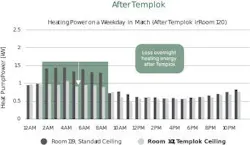
PCM ceiling installations can also improve energy efficiency and thermal comfort in colder regions. Spaces in these climates are typically uncomfortably cold in the morning, then experience noticeable afternoon warm-ups due to occupancy and sunlight. The PCM ceilings absorb excess heat through the afternoon, storing then releasing it overnight. This makes the space more comfortable in the morning without the need to “blast” heating systems in an effort to catch up.
The Complete Picture of PCM Advantages
Beyond playing a key role in strategies to reduce a facility’s energy use and carbon footprint, lower utility expenditures, and improve efficiency, PCM ceilings work in other ways to improve occupant comfort, well-being, and the bottom line. It is the complete PCM ceiling picture that has an increasing number of building owners and facility managers, as well as architects and specifiers, turning to these solutions for new construction, renovations, and retrofits.
Many of these benefits existed when PCM technology was first introduced to mineral fiber ceiling panels, integrating with thermal comfort to broaden the scope of the ceilings’ contributions to Indoor Environmental Quality (IEQ) and adjacent topics. Most notably, since the start, PCM ceilings have enabled:
- Better acoustics—offering sound absorption (noise reduction coefficient of approximately 0.75-0.85) and sound blocking (ceiling attenuation class of approximately 39-40)
- Lower supply-chain risk and support for ESG (Environmental, Social and Governance) goals—being made in the U.S.A. of domestic and global content, and Build America, Buy America (BABA) compliant
- Sustainability and wellness certifications—fitting into the thermal comfort portion of the WELL Building Standard, can contribute to LEED v5 credits
In addition, recent design modifications make PCM ceiling panels free of Red List chemicals, further increasing IEQ benefits.
There are also several advantages of PCM ceilings that come into play when designing a new build or renovation. Together, these can help keep projects on time and on budget, reduce overall project costs, and facilitate ceiling maintenance.
To start, PCM ceilings now offer two sizes (24 by 24 inches and 24 by 48 inches). This allows them to be easily installed using a standard grid system and provides an attractive solution for retrofits. Panels are also lightweight and can typically be installed or replaced by one person.
Also making recent headlines is the inclusion of PCM ceilings in energy-modeling software, a building-optimization opportunity that is growing in both popularity and necessity. Energy modeling simulates the effect of PCM ceilings and allows for accurate predictions of their impact on energy and HVAC use, thermal comfort, HVAC sizing, and compliance with energy codes and sustainability and wellness standards.
Lastly, because of their energy-storage properties, projects incorporating PCM ceiling panels meet the guidelines of the 48E Clean Energy Investment Tax Credit (ITC). These projects may qualify for a 40% federal tax credit and an additional 10% tax credit if the project is deployed in an “Energy Community.” In addition to the ceiling panels, associated grid, trim, and labor may also qualify for tax credits under ITC 48E. Leveraging clean-energy incentives can reduce overall project investment costs and support stronger financial performance. In one recent case contributing factors in a new corporate office project brought the 48E tax credit for the renovation to more than $25 per square foot, approximately 37% total savings of the final project.
Taking the Pressure Off of Owners and Managers
Today’s owners and managers are under a ton of pressure to operate buildings that not only support all key functions that are supposed to happen in them, but to do so in a way that is environmentally responsible and prioritizes occupant wellness. Moreover, tremendous stress on the energy grid is driving up costs and presenting unprecedent challenges for ensuring uninterrupted operation while staying within set budgets. Whether the building is for-profit or a nonprofit entity, such as healthcare, education, workspace, recreation, and more, PCM ceilings deliver critical advantages that start “at the top” with improved thermal and occupant comfort and continue through to bottom-line impacts driven by energy-saving strategies.
About the Author
Mick Dunn
Michael “Mick” Dunn is product manager, energy saving ceilings, for Armstrong World Industries. He is passionate about developing and deploying products and solutions that incorporate Phase Change Materials (PCM) in the construction industry. Mick’s 20+ years of construction management experience include being Founder/Owner of the Maine-based Shift Energy, LLC, which specializes in large-scale commercial solar heating systems. In 2015, Mick co-founded Insolcorp, LLC, and continues to focus on the need and interest for dynamic ways to store thermal heat and improve the sustainability and resiliency of the built environment.