What a Cleaning Contractor’s Daily Handover Should Tell You
Key Highlights
- Begin with a brief summary of completed work, including location and time window, to provide context at a glance.
- Clearly define what constitutes a completed record, distinguishing between visits, photographs, and check-ins, to ensure accurate reporting.
- Separate routine confirmation records from supervisor inspections to maintain clarity on work quality versus completion status.
- Use supporting evidence like photos and timestamps strategically, placing them next to relevant questions for quick reference.
- Assign specific next actions to the appropriate party, clearly stating the location, problem, and decision needed to facilitate prompt follow-up.

A useful daily cleaning report helps a building manager answer three questions: what work was completed, what needs attention, and who needs to act next. The challenge is keeping those answers visible without turning the report into a long activity log or an unexplained list of red flags.
This is a reporting design problem as much as a technology choice. A spreadsheet, a shared document, or a specialist system can follow the same structure. Begin by agreeing the meaning of each status, then organize the handover around decisions the reader can make.
Lead with Completed Work
Open with a short account of the work completed during the reporting period. Name the round or area and give the relevant time window. A sentence such as “The morning restroom round was completed before the building opened” tells the reader more than a list of individual entries without context.
Keep the supporting records available, but give them a different job from the summary. The summary explains the day; the detailed record helps someone investigate a question. Putting every timestamp into the first screen can obscure the one issue requiring a decision.
Define What a Completion Record Means
A visit, a photograph, and a completed check are different records. A photograph may illustrate a condition, but it should not automatically mark every planned task complete. If your process uses QR codes or NFC tags, distinguish opening the tag’s page from recording completed work. Neither independently establishes the quality of the cleaning.
Agree which action records completion and what additional evidence is appropriate. Keep routine confirmation distinct from a supervisor’s quality inspection. If a record is missing, describe that gap accurately rather than treating the absence of an entry as proof that no work occurred.
Give Each Reader the Right Next Action
Separate the contractor’s own follow-up from matters requiring the building manager’s help. A replacement mop is usually a team matter. Access to a locked meeting room may need the client’s action. Both deserve a record, but they should not compete for the same attention in the client summary.
For each client action, identify the location, the practical problem, and the decision needed. “Please arrange access to the second-floor meeting room for tomorrow’s round” is more useful than “Second floor incomplete”. The contractor’s team view can carry the fuller work list without making the client search through it.
Explain Work That Was Held Up
When work cannot proceed, give the reason and the next step together. “Room occupied during the agreed cleaning window; access requested for the next visit” distinguishes an access dependency from an unexplained omission. Keep the explanation in the team’s own words, with enough detail to understand what happened.
Avoid converting explanations into a performance score. A reason is context for resolving a problem, not a substitute for the agreed service standard. If work is completed later, retain the earlier explanation and record the later completion so that the sequence remains understandable.
Use a Short Supervisor Review
Before sending the client update, give the responsible supervisor a short review of the summary, open issues, and explanations. Check that the report covers the intended period, that exceptions have not been assigned to the wrong party, and that outstanding actions remain visible.
Review should not silently rewrite the underlying record. If an entry needs correction, preserve the change and its context. A supervisor’s approval means the update has been checked for release; it should not be presented as independent proof of every surface’s condition.
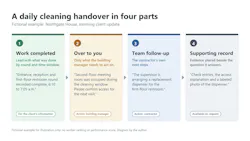
A Fictional Handover
The following example is entirely fictional. It illustrates a structure, not an actual customer’s performance:
Northgate House: morning client update
Work completed: The entrance, reception and first-floor restroom round were recorded complete between 6:10 and 7:05 a.m.
Over to you: The second-floor meeting room was occupied during the cleaning window. Please confirm access for the next visit.
Team follow-up: The supervisor is arranging a replacement dispenser for the first-floor restroom.
Supporting record: Check entries, the access explanation, and a labeled photograph of the dispenser remain available for review.
There is no worker ranking or invented percentage in this example. The client can identify their action, while the contractor retains ownership of its own follow-up. The detail supports the summary instead of making the reader reconstruct it.
Make the Evidence Useful
Place evidence beside the question it helps answer. A photograph of a damaged dispenser belongs with that issue. A timestamp belongs with the check it records. A short explanation belongs with the work held up. An unlabeled gallery or a list of scans leaves the reader to make connections the report should already explain.
Keep individual worker details in the contractor’s appropriate internal view rather than including them by default in a client-wide update. Check who can open supporting links, particularly when several contractors work in one building. A forwarded summary should not give a new recipient unrestricted access to operational records.
Finish with Ownership
Carry an unresolved client action into the next handover until it is answered or otherwise resolved. Distinguish that answer from completion of the cleaning task: arranging access and doing the work are separate steps. Keep the relevant times visible so that an old issue does not read as a new event.
The practical test for a daily handover is whether its reader can identify the next action without reopening the whole history. A concise summary, clear ownership and accessible supporting evidence make that possible while keeping the record fair to the building manager and the service team.
About the Author
Terry Sullivan
Terry Sullivan is the founder of SiteClara, which brings staff records into supervisor-reviewed client reports.