Adaptive Reuse Made Simple: How Above-Floor, Pump-Assisted Plumbing Systems Turn Landmarks and Left-Behind Offices into Livable Residential Spaces
Key Highlights
- Major cities are repurposing vacant office spaces into housing, hotels, and lofts to combat housing shortages and reduce construction timelines.
- Policy incentives such as tax abatements and zoning updates are encouraging adaptive reuse projects across the U.S. and beyond.
- Above-floor, pump-assisted plumbing systems allow for quick, cost-effective retrofits without damaging existing structures, supporting historic preservation and sustainability.
- These plumbing solutions support a variety of applications, from single units to multi-floor commercial conversions, with minimal disruption and faster installation times.
- Emerging innovations aim to make plumbing systems quieter, more efficient, and smarter, further streamlining adaptive reuse efforts in urban environments.
Walk through any major downtown—Los Angeles, Chicago, or New York—and you’ll likely notice the same thing over and over. Office spaces are sitting empty, many of them for sale or lease, waiting for a second life.
Meanwhile, these same cities face a stubborn housing shortage.
The disconnect is apparent: too many vacant offices, yet not enough homes.
Developers and city governments are now rethinking how to repurpose existing commercial structures. Instead of constructing new towers, they are “building out” existing ones, turning obsolete offices into housing, hotels, and lofts.
According to RentCafe, office-to-residential conversions have surged to a record 25,000 apartments, with Chicago overtaking Manhattan as the top city for conversions. This adaptive reuse trend has become one of the fastest ways to add housing without the years of permitting and ground-up construction typically required.
According to Steve Winter Associates, policies in many cities are loosening to encourage adaptive reuse:
- Washington, DC: This city offers up to 15 years of property tax abatements through its “Office-to-Anything” program.
- Montgomery County, Maryland: This community proposes a 20-year property tax exemption for conversions with affordable units, along with a new zoning category that would ease approvals.
- Arlington, Virginia: This city fast-tracks conversions (120-150 days) and allows density bonuses for affordable or green projects.
- Alexandria, Virginia: Zoning updates permit housing in commercial spaces and grant bonuses for affordability and sustainability.
- Massachusetts: Its Commercial Conversion Initiative provides grants and planning support.
- New York State: New York City’s “City of Yes” reforms expand conversion eligibility, while Buffalo offers tax incentives for reuse projects.
The Quiet Kingmaker: Plumbing
While architecture and policy grab the headlines, one foundational factor—such as existing structural systems and infrastructure—determines whether a retrofit succeeds.
According to Steven Winter Associates, conversions can significantly shorten the timeline from project start to move-in, especially when paired with new incentives and the sustainability benefits of keeping the existing structure intact. These adaptive reuse projects can transform underused spaces into vibrant housing with thoughtful planning and an understanding of both the building’s physical limitations and evolving regulatory frameworks.
For many developers, a central question becomes how to incorporate residential plumbing into commercial shells without significant disruption. Traditional plumbing often requires cutting into slabs and rerouting pipes, a slow and costly process that can be particularly challenging in older or historic buildings.
Above-floor, pump-assisted plumbing systems offer an alternative by allowing wet areas such as bathrooms, kitchens, and laundry rooms to be added without trenching into slabs or disturbing existing finishes.
How Above-Floor, Pump-Assisted Plumbing Systems Work
In landmark buildings, protecting structural slabs and preserving finishes is essential. Above-floor plumbing provides a viable means of adding drainage without compromising these elements.
These pump systems offer an efficient alternative to the time-consuming, labor-intensive trenching required by conventional plumbing. While you may be familiar with “up-flushing” toilets that use a pump to move waste, macerator and grinder technology enhances this process by grinding solids and pumping wastewater through small-diameter pipes. This helps prevent clogging and allows for flexible installation.
Unlike conventional below-floor systems that require cutting through concrete or extensive excavation, macerating/grinding (or above-floor) plumbing systems move wastewater from toilets, tubs, showers, or sinks through a pump unit that reduces solids before sending the effluent upward or laterally to the main drain line connected to a sewer or septic system.
Similarly, a drain pump is a compact unit designed to automatically discharge graywater from sinks, showers, or appliances to the main drain line when gravity flow is not available or practical. These systems allow plumbing fixtures to be installed virtually anywhere in a building, office, or home, such as finished floors in attics, spare bedrooms, garages, or utility rooms. Installation is fast, economical, and minimally disruptive. Some systems are fully operational in as little as half a day.
Demonstrated Impact: Use Cases and Projects in Action
Two use cases dominate:
- Single Unit: Single-unit applications that use compact pump systems capable of supporting bathrooms, sinks, or laundry appliances.
- Light-commercial and multi-unit: Multi-unit or light-commercial applications that use larger lift stations to support multiple fixtures or entire floors.
For example, at 15950 Vista Towers in Clearwater, Florida, Wayne Cassity, owner of ABA Constructors Inc., had his project team faced with the challenge of converting a 59,000-square-foot, three-story office building into a mixed-use residential and hotel property without disturbing tenants still occupying the floors below. To build over 120 bathrooms, as well as laundry and kitchen facilities, the developers opted for a full above-floor plumbing strategy utilizing lift stations.
Each unit relied on pump systems capable of managing toilets, showers, and sinks, with fixtures tied into a newly installed horizontal gravity line in the hallway. Laundry and kitchen fixtures were similarly supported with dedicated gray-water pumps.
This strategy eliminated the need to core through structural concrete floors and reduced tenant disruption. Installers were able to complete each unit’s system within a couple of days.
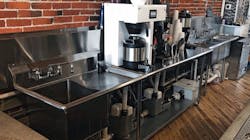
Another example: Revelstoke Coffee shop owner, Alex Stoyle, faced a unique plumbing challenge when setting up his café inside a 200-year-old historic building. The structure’s age meant that the existing plumbing system couldn’t easily accommodate the modern commercial kitchen’s layout. In a 200-year-old historic building, the café installation used multiple drain pumps to manage gray water from several fixtures, avoiding the need to disturb stone foundations or reroute gravity drainage lines.
Other adaptive reuse projects range from compact hospitality spaces, such as the Sheridan Guest House in Leith, Scotland, a suburb of Edinburgh, where above-floor systems allowed the addition of ensuite bathrooms in tight quarters, to even more ambitious ventures like the Sula Lightship, which was transformed into a luxury accommodation while maintaining its original marine structure.
These real-world restorations demonstrate that adaptive reuse doesn’t have to sacrifice authenticity. Instead, it enables historic character to coexist with modern performance.
Sustainability You Can See
Even if a pump doesn’t appear on a LEED scorecard, its impact is tangible:
- Avoiding demolition means less waste, less concrete removal, and fewer truck trips, saving energy.
- Water-efficient fixtures can be paired with above-floor plumbing systems to support conservation goals.
- Efficient pump motors help reduce energy use, contributing to more sustainable retrofits.
What Owners And Tenants Actually Experience
Owners and tenants benefit from lower installation costs, faster project timelines, and quieter performance. Retrofits that once required extended downtime can often be completed with minimal disruption. Maintenance demands drop, and tenants appreciate not having to deal with noisy or unreliable plumbing.
Similar approaches have been used in retail settings, where above-floor systems allow new sinks or dishwashers to be added without cutting into concrete or disrupting operations.
The same principle now drives many heritage and office-to-loft conversions thanks to the speed, flexibility, and zero downtime that easy-to-install above-floor plumbing permits.
Answering the Biggest Misconceptions
Two myths persist:
- Myth 1: Above-floor plumbing pumps are temporary.
- Myth 2: Above-floor plumbing pumps are unreliable.
In fact, the technology dates back to the 1950s and has proven itself as a permanent, long-term solution in thousands of varied and challenging applications. Many legacy units still run decades later, demonstrating earned, not claimed, durability.
What’s Next: Smarter, Quieter, Higher-Capacity
The next wave of innovation focuses on refinement. Emerging systems offer quieter operation, greater efficiency, and higher capacities suitable for multi-unit retrofits. The future also holds promise for more intelligent systems, such as radar-based water detection, integrated alarms, and smart building connectivity. The goal is plumbing so advanced you hardly know it’s there.
The Bottom Line
If adaptive reuse is increasingly supported by public policy, above-floor plumbing often serves as the behind-the-scenes infrastructure enabling many of these projects. It preserves character, compresses timelines, and unlocks floor plans without the need for a jackhammer.
Once you’ve seen the speed and flexibility of above-floor pump systems in making a conversion, it’s hard to go back to the old-school way.
About the Author
Chris Peterson
Chris Peterson is Director of Sales - West & National Accounts Manager for SFA Saniflo.