Why Building Measurement Has Become a Specialized Discipline
Key Highlights
- Measurement standards have expanded significantly since their inception, now encompassing multiple building types and requiring specialized knowledge for proper application.
- Traditional methods of measurement, relying on design or as-built documentation, are insufficient for managing the complexities of modern, dynamic building portfolios.
- Rentable area functions more like an accounting system, where continuous changes necessitate rigorous tracking, documentation, and periodic audits to maintain data integrity.
- A new role of space accounting specialists has emerged, focusing on ongoing management, change control, and ensuring measurement consistency over a building's lifecycle.
- Understanding and applying measurement standards as a governance tool allows owners to make informed, defensible leasing and asset management decisions amidst evolving building use scenarios.

For decades, building measurement was treated as a technical task that could be handled alongside design or documentation. An architect would apply a standard, a drawing set would be issued, and rentable area was assumed to be settled. That assumption made sense when standards were simple and buildings were comparatively static.
Today, that assumption no longer holds.
Measurement standards have expanded dramatically in scope, detail, and application, while buildings themselves have become more dynamic assets. Lease-up strategies, tenant improvements, phased occupancies, and evolving use types now place continuous pressure on the assumptions behind reported rentable square footage. What was once a one-time calculation now behaves like an accounting system that must be managed over time.
For owners and asset managers, this shift has real consequences. Rent rolls, proformas, and lease documents depend on numbers that are often established early and then quietly altered by design decisions, suite reconfigurations, and interpretation choices made along the way. The challenge is no longer simply measuring space accurately, but maintaining control over how that space is defined, tracked, and defended.
Understanding why this problem exists requires looking not just at buildings, but at how measurement standards themselves have evolved.
The Quiet Expansion of Measurement Complexity
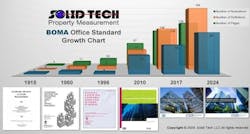
The first BOMA office measurement standard, introduced in 1915, was concise with only a few pages of content. For much of the 20th century, its scope remained relatively stable. Even by 1980, more than six decades later, the standard had expanded only modestly.
That changed dramatically beginning in the 1990s.
The 1996 edition of the office standard roughly doubled in size and introduced more technical definitions. With the 2010 BOMA Office standard, the number of defined terms increased again by more than 500%, and the document itself more than tripled in length. Subsequent editions continued this trajectory. Definitions doubled again in 2017, and the 2024 release added significant visual guidance, with a substantial increase in illustrations intended to clarify increasingly nuanced scenarios.
At the same time, the success of the office standard prompted the creation of additional measurement standards covering industrial, retail, gross areas, multifamily and hospitality, and mixed-use buildings. In addition, these standards are revisited and refined on an approximately five-year cycle to maintain ANSI certification. As a result, across six BOMA measurement categories, nearly 20 active standards are now in common use, each with its own definitions, edge conditions, and interpretive challenges.
This growth reflects real market needs. But it also means that applying measurement standards correctly within real leasing scenarios now requires far more than basic familiarity with the standards. It requires specialization.
The Two Common Approaches and Their Limits
In practice, owners often rely on one of two approaches.
In the first, architects or designers apply measurement standards internally as part of design or documentation efforts. This approach benefits from strong building knowledge and design intent, but it assumes that measurement expertise can remain a secondary skill. As standards have expanded and diversified, that assumption has become harder to sustain, particularly when projects involve multiple tenants, phased lease-up, or evolving boundaries.
In the second approach, owners engage as-built drafting firms to capture existing conditions, with measurement or BOMA calculations added as an ancillary service. These teams are often highly efficient at documentation and field capture, but their primary focus is producing drawings. Measurement standards may be applied procedurally, without the accounting-style rigor required to manage assumptions, track changes, and reconcile impacts over time.
Neither approach is inherently flawed. But both reflect an older model in which measurement is treated as a deliverable rather than a discipline.
Why Area Behaves Like Accounting
Rentable area functions much more like an accounting system than a drawing.
An initial measurement establishes a baseline. From that point forward, design decisions, tenant improvements, suite splits, and common area reallocations act like transactions. Each change may appear minor in isolation, but collectively they can materially alter reported rentable square footage if they are not reviewed, documented, and reconciled consistently.
Without periodic audit and controls, assumptions drift. Drawings, lease exhibits, and rent rolls gradually diverge. By the time discrepancies surface, they are often embedded across multiple documents and difficult to unwind.
Treating area as an accounting system reframes the task. It emphasizes governance, documentation, and continuity, but it also clarifies where judgment is applied and where choices can be made deliberately. Just as accounting rules do not dictate business strategy, measurement standards do not determine outcomes on their own. They create a structured framework within which owners can evaluate options, test assumptions, and defend decisions over time. This approach aligns more closely with how buildings actually operate over time and with how owners manage financial risk.
The Emergence of Space Accounting Specialists
As this complexity has grown, a distinct category of practice has emerged: measurement and space accounting specialists who focus exclusively on the application, management, and continuity of area standards.
Unlike general design teams or drafting providers, these specialists treat measurement as an ongoing technical role. They apply accounting-style practices to baseline control, change management, auditability, and lifecycle tracking. Their work is less about producing drawings and more about maintaining the integrity of the data that underpins leasing and valuation decisions.
Industry organizations have begun to recognize this specialization formally. BOMA International, for example, identifies a small group of practitioners who serve on its Floor Measurement Standards Committee and act as resources for interpretation questions and ongoing standards development. This reflects an important shift. Accurate area reporting today depends not only on knowing the rules, but on participating in how those rules are clarified, refined, and applied in real leasing scenarios.
More broadly, the trend signals a maturing view of building measurement as a form of governance rather than a one-time task. When applied deliberately, measurement standards do more than ensure compliance. They give owners a structured way to evaluate trade-offs, test scenarios, and make informed decisions about leasing strategy, tenant improvements, and asset repositioning. For owners and asset managers navigating increasingly complex portfolios, the question is no longer who can measure a building once, but how effectively they can use the rules to support defensible outcomes as conditions change.
About the Author
Garett Naff
Garett Naff, AIA, is a licensed architect and Principal at Solid Tech Property Measurement, a Colorado-based building measurement and space accounting consultancy. He serves as Co-Chair of BOMA International’s Floor Measurement Standards Interpretations Committee and has contributed to multiple ANSI and BOMA measurement standards. His work focuses on helping owners and asset managers maintain accurate, defensible area data across the lifecycle of commercial buildings.
Solid Tech Property Measurement is a Colorado-based consulting firm specializing in building measurement and space accounting for commercial real estate. The firm supports owners, asset managers, and design teams nationwide with BOMA-compliant area analysis and existing conditions documentation for office, industrial, multifamily, and mixed-use assets.