Top 3 Trends Driving Lighting Innovation Today (Light + Building 2026)
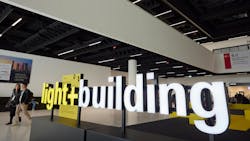
The lighting industry is constantly shifting, with its dynamic nature driven by forces from the rise of connected buildings and digitalization to new demands from building occupants. Light + Building—the world’s premier trade fair for lighting and building services technology—tackled these shifts and more in its 2026 exhibition in Frankfurt, Germany.
Messe Frankfurt, the organization presenting Light + Building, invited BUILDINGS to the show to explore these three themes featured at the event—and more. Here’s what we found on-site—plus five key takeaways for building owners and facilities managers.
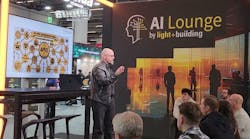
Sustainable Transformation
Exhibitors at Light + Building were eager to explain their companies’ sustainability stories. Lighting accounts for about 17% of electricity consumption by U.S. commercial buildings, according to the 2018 Commercial Buildings Energy Consumption Survey by the U.S. Energy Information Administration—meaning that it’s not the biggest contributor to energy use in commercial buildings, but it’s still a significant contributor to building energy consumption.
In a March 9 press conference at Light + Building, Signify unveiled its new five-year sustainability plan, “Brighter Lives, Better World 2030.” The initiative, now in its third phase, features commitments to manufacturing with low nature impact, inclusive workplaces, and more. The company also discussed Signify Circle, a commitment to scale products and circular services (such as remanufacturing models and upgrade kits) that enable a “use less, use longer, use again” framework and help reduce the consumption of virgin materials.
“This is about reducing our dependency on scarce resources, minimizing waste and creating long-term value for our customers,” said Maurice Loosschilder, Signify’s global head of sustainability. “We will be scaling circular products that are designed to be upgraded, repaired, refurbished, and ultimately recycled.”
Companies like Ledture—a manufacturer of high-performance LED lighting for sports venues, transport infrastructure, and industrial facilities—also offer products designed to be repaired or upgraded. The modular design of Ledture’s marine-grade products allows technicians to change out components and maintain the units on-site rather than sending them back to the manufacturer for service—a feature that’s not only sustainable, but economical for the owner, explained Oliver Newman, general manager and sales director of Ledture.
Some manufacturers, like WAC Group, shared commitments to sustainability in areas you might not expect—proving that your supply chain can embrace green strategies despite the historical challenges with reducing supply chain-related emissions. Not only does the company also offer modular, field-repairable fixtures, it also designed its own plastic-free crates and pallets that are more environmentally friendly. WAC Group also covers 60% of its facilities’ energy needs with solar power, said Leigh Gice, director of product marketing.
EnOcean, which developed wireless, battery-free sensor technology for use by OEMs, approaches the sustainability conversation from two sides. Its sensing devices are often used to measure energy consumption, and its lack of batteries means facilities managers aren’t tasked with disposing of thousands of tiny batteries throughout the course of the devices’ life.
“Start simple. Don’t think about the very complex [applications],” suggested Markus Florian, chief commercial officer for EnOcean. “Step by step, upgrade. The technology allows you to start simple and then grow and have additional possibilities, like additional sensors, receivers, and gateways. Understand the technology and possibilities, and then expand.”
Smart Connectivity
Control systems in buildings are becoming highly complex, but some manufacturers are taking concrete steps to combat the complexity. WAC Group, for instance, decided to make many of its products manufacturer-agnostic so they can be used with multiple control systems. “We don’t care whose controller you use—we speak a lot of those basic protocols,” Gice said.
Autani, a 20-year-old smart building technology company, showcased its portfolio of advanced wireless sensors, connected thermostats, EnergyCenter management software, and more. Its intelligent, web-based platform allows users to have one central source for energy monitoring and reports, status monitoring, and other management tasks. Regulations, including Building Energy Performance Standards (BEPS), are increasingly requiring energy reporting, so platforms that can handle data collection for you can simplify compliance.
“We’re doing what the utilities are seeking, which is using lighting sensors to control HVAC so you’re not heating and cooling spaces where people are not,” explained Chris Primous, EVP of sales and marketing. “We can control that from our central EnergyCenter platform. By having all of that in one system, it helps people do what the market is starting to demand.”
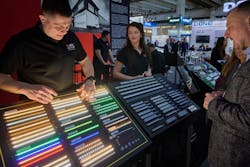
Living Light
The third theme highlighted at the show, Living Light, spoke to the need for human-centric solutions that take occupants’ needs into account. Ledvance showcased systems with lighting color adjustment controlled by simple hand gestures, while Signify described how connected lighting “should enhance life, not overwhelm it.”
“Technology alone is not the goal,” said Greg Nelson, Signify’s EVP and business leader, professional systems and services. “Connected lighting is designed for people. It creates engaging spaces that promote health, wellbeing, and security.”
5 Takeaways for Building Owners and Facilities Managers
What can property and facility professionals learn from an event like Light + Building? We gathered these top action items from exhibitors.
- Don’t try to DIY. Hiring a lighting designer can pay off in numerous ways, said George Moghaizel, CEO of Bold Lighting. “When specifying performance products, the best firms to advise on that would be lighting design companies, because they are working on it day to day in terms of what’s on the market and what works best,” Moghaizel said. “Do it very early [in the process].”
- Look for modular systems when possible. Being able to repair your fixtures in the field helps you get them back into service faster.
- Make sure you understand the specs. Different LED products may have different temperature ranges they can operate in, which could make a big difference if you’re buying outdoor lighting in an area prone to extreme heat or cold, Newman said.
- Use common sense. Understand how long you need the product—and the project it’s going into—to last and plan accordingly, said Michael Rowsey, national sales manager for Tokistar.
- Educate yourself on product innovations and building codes. Codes and regulations change regularly, and if you don’t keep up with the code cycles, you may find yourself scrambling when your jurisdiction adopts a new version of the International Energy Conservation Code (IECC) or another code that could impact your purchasing decisions. “Make sure you’re abreast of the latest technology and learn about what’s out there,” Primous said. “You have to know what’s out there to accomplish the tasks you’re going to need to meet those codes.”
One example is exit sign and emergency lighting testing, Primous added. Autani launched a system that allows users to schedule testing automatically with a mobile app, then stores the test results in the cloud for easy access.
About the Author
 Janelle Penny
Janelle Penny
Editor-in-Chief at BUILDINGS
Janelle Penny has been with BUILDINGS since 2010. She is a two-time FOLIO: Eddie award winner who aims to deliver practical, actionable content for building owners and facilities professionals.