When the Impossible Becomes Possible (BOMA 2026)
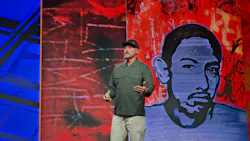
Have you ever been confronted with a tough property problem and had the thought, “This is impossible”? Most people have—but the very idea of impossible is a fallacy, explained Mick Ebeling.
In a moving keynote at the 2026 BOMA International Conference & Expo, Ebeling—founder and CEO of Not Impossible Labs—told the audience that all the modern conveniences today, from the phones in attendees’ pockets to the seats they were sitting on—were thought impossible until inspiration met execution. Ebeling’s philosophy of “Commit, then figure it out” has delivered change throughout his life, and it can do the same thing for property professionals.
“Think about something in your home that’s possible today that wasn’t impossible first,” Ebeling said. “What about clothes? What about utensils?... Every single thing that surrounds us right now that’s possible, at some point was impossible. Doesn’t that lead us to believe that everything that’s possible today, based on history, on data, on science, was impossible first?”
Inventing the EyeWriter
“Commit, then figure it out” is the driving force behind Ebeling’s most enduring solutions. Not Impossible Labs itself emerged from his work with the late Tony Quan, also known as Tempt One, an iconic Los Angeles graffiti artist who developed amyotrophic lateral sclerosis (ALS). Quan hadn’t drawn in seven years as the disease robbed him of his abilities. After attending a showcase of his art, Ebeling immediately decided he wanted to help Quan draw again—but he didn’t have the technical skills to help.
“The act of what I did on that day by telling [Quan’s family] that I could do that, with no reason or rationale that I could actually pull it off, is part of how we operate,” Ebeling explained. “When you see something absurd, when you look at something and say, ‘That’s not right, the world shouldn’t work that way, this has to change,’ what we call that is commit. And then figure it out.”
Property professionals already do this to some extent, Ebeling said. “Every single one of you execute this on the daily,” he explained. “How many of you set your goals at the beginning of this year and knew exactly and precisely how you were going to pull it off?”
Ebeling’s decision eventually birthed the EyeWriter, a communication device built from a pair of sunglasses and a duct-taped webcam. Quan used the EyeWriter to draw from his hospital bed despite being fully paralyzed, and Ebeling had a reckoning of his own as he came to understand that technology for the sake of humanity could help people. He and his team determined that because they didn’t have unlimited funding to do whatever they wanted, they had to get scrappy to scale the things they were making—and storytelling was how they would do that.
Help One, Help Many
Ebeling also told the audience the story of Dr. Tom Catena, an American surgeon who has practiced in Sudan since 2008. Ebeling was reading about Catena’s work one night and discovered that the doctor hates to perform amputations—and he was charged with doing many of them due to the brutality of the war in Sudan. Catena talked at length about Daniel, a child whose life he saved. Daniel was tending his family’s animals in an open field, saw bombs coming, and immediately ran behind a tree. His quick decision protected his body from the blast, but because he wrapped his arms around the tree, both arms were blown off.
“He’s 15 years old. My 15-year-old was asleep 30 or 40 feet from where I was reading this,” Ebeling explained. “The first thing this kid said when he woke up was, ‘If I could die, I would, because now I’m going to be such a burden to my family.’ He’s not thinking about himself, he’s thinking, ‘I’m going to be such a pain in the butt to my mom and dad.’”
Ebeling knew he had to help—but how? Existing prosthetics can cost $15,000 or more, so Ebeling got to work with his team trying all kinds of different strategies. Eventually they created the first prosthetics lab powered by 3D printers—it created Daniel’s new arms for about $100 each. Four months to the day after Project Daniel launched, Daniel fed himself for the first time with a 3D-printed arm. Last year, Daniel passed the U.S. GED and has been accepted into Santa Monica College.
“When I first got there, Daniel was very forlorn and wouldn’t pay attention. At the end he was punking me and hitting me in the head with balloons,” Ebeling described.
Leadership isn’t just about working with and employing other people, Ebeling added. When people have a purpose of why they work with you or for you, it gives them a newfound passion and enthusiasm for staying with you. “What’s your victory going to be? What’s the story that you’re going to tell with your life?” Ebeling asked the audience. “How are you going to use those blessings? Are you going to keep it to yourself or are you going to take that ability you have as a professional—as problem solvers, connectors, and doers—and try to do things within your own world?”
About the Author
 Janelle Penny
Janelle Penny
Editor-in-Chief at BUILDINGS
Janelle Penny has been with BUILDINGS since 2010. She is a two-time FOLIO: Eddie award winner who aims to deliver practical, actionable content for building owners and facilities professionals.