State of the CRE Industry: Recovery Is Here—But It Looks Different (BOMA 2026)
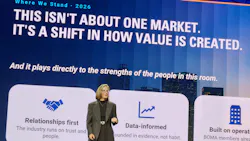
“Last year, a year ago, our industry was holding its breath. Capital was on the sideline. Buyers and sellers were far apart,” Mary Lue Peck, BOMA International’s president and chief operating officer, told the crowd during her always-anticipated State of the Industry address at BOMA’s 2026 conference. “Today, that picture is changing.”
How is it changing? Debt is generally more available than it was even just a year ago, signaling a willingness to invest. But different sectors are experiencing the recovery differently, and property professionals in general will notice that conditions have changed since the pre-COVID days. Recovery is here, but it’s selective in a way that rewards performance and penalizes friction, Peck explained.
It’s About Operations
Investors still care about returns, but not exclusively, Peck said. “They want to understand how much it costs to run a building, how that’s trending, and whether you can demonstrate that in real time,” Peck said. “Buildings used to sit and perform over time. The ones that are attracting capital today behave more like living systems. They generate data. They respond. They adapt. They tell their owners how they’re performing in real time. We’re moving from static assets to living portfolios, and that shift is showing up in practical ways all across our business.”
You might operate an office building that runs at 65-70% capacity on a Tuesday and just 20% on a Friday due to hybrid working models. Such a building “isn’t just one operating profile, it’s two,” Peck said. “Services, staffing, energy—everything has to flex based on real demand, and we’re seeing this consistently in the data shared by our partners.” The real planning challenge isn’t the monthly average or even the weekly average, Peck added—it’s the peak day.
The People Who Measure Get Paid
Data from Trane indicates that roughly 12% of building energy is wasted by inefficient operations, Peck said—but new technologies, such as AI-driven controls, are already starting to close that gap. “As capital starts pricing performance, investors are looking for buildings that can demonstrate results, not just promise them,” Peck said.
This is where third-party performance verification programs like BOMA BEST come in, she added. The certification process provides a roadmap to enhance the way you operate your building, leading to better results—and happier investors.
Risks Are Shifting
Financial risk dominated the conversation for years, Peck said. Those pressures haven’t disappeared, but operational risk is taking up a bigger share of the conversation than it used to. Two-thirds of security officers anticipate security budgets to increase, and threats toward executives are more common than they used to be.
“When a major incident hits, it’s not just the downtime and the disruption—it can materially affect a company’s value,” Peck said. “Downtime is a business risk. It’s operational, and it’s expensive.”
People and technology are converging to mitigate these risks, Peck added. For example, AI-powered cameras can now detect and flag unaccompanied bags for your security staff to check out.
“The technology alerts trained people on the ground to evaluate, prevent, and deescalate,” Peck said. “The most resilient operators aren’t chasing between technology and people—they’re integrating both.”
New Tools Are Empowering Property Managers
Artificial intelligence and other new tools are helping make quick work of mundane tasks, which enables property professionals to shift their time to higher-value work that requires human creativity. “Technology is not going to replace operational excellence—it will amplify it,” Peck said.
“The buildings catching capital are the ones that can show their work, the ones who adjust, the ones whose teams act on data,” Peck added. “Commercial real estate is being refined, and this is exactly where BOMA members shine. Operational excellence has always been your sweet spot—the difference now is that the market is finally paying for it. The work that defines this moment, running buildings well, is the work you’ve all been leading this entire time. It’s a good time to be in this business, and it’s an even better time to be the people who do it best.”
About the Author
 Janelle Penny
Janelle Penny
Editor-in-Chief at BUILDINGS
Janelle Penny has been with BUILDINGS since 2010. She is a two-time FOLIO: Eddie award winner who aims to deliver practical, actionable content for building owners and facilities professionals.