Why Your Fire Alarm System Passes Inspection—But May Still Fail in an Emergency
Key Highlights
- Acceptance testing verifies system compliance under controlled conditions but may not reflect real-world performance factors such as obstructions or environmental influences.
- Design considerations should include actual building conditions, sight lines, and environmental suitability to ensure notification appliances and detectors function effectively during a fire.
- Human behavior, including false alarms and alarm fatigue, significantly impacts system effectiveness; proper training and maintenance are essential to maintain occupant trust and safety.
- Ongoing inspection, testing, and maintenance are vital to address issues like sensor degradation and physical obstructions that can compromise system performance over time.
- Building owners should establish contracts with qualified ITM providers early to ensure continuous system effectiveness and adherence to safety standards.
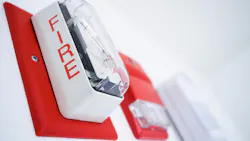
After much work from all trades, it is time for the final fire alarm inspection. The question on everyone’s mind is: does this system and installation meet code? That is the right question to ask for a code official, whose role is to verify compliance. But for the designer, contractor, or life safety inspector who is not only concerned with code compliance but also with the real-world functionality of the system, the right question to ask is: if there is a fire in this building tonight, will this system actually protect the people inside?
These two questions don’t always have the same answer. The professional who understands the difference is the one who designs, builds, and maintains systems that not only meet code but also perform reliably when it counts most.
Code Compliance
All fire alarm systems are designed and installed to conform to NFPA 72: National Fire Alarm and Signaling Code, along with other applicable standards, to establish the minimum requirements for any fire alarm project. These standards also provide the basis for acceptance testing, also known as the final inspection, which verifies that the system complies with its requirements.
The typical acceptance test involves activating and testing all fire alarm panels, power supplies, initiating devices, and notification appliances, and verifying that each meets its specific requirements. Acceptance testing sounds thorough, but it has its limitations. It is performed under controlled conditions and does not always account for the real-world factors that affect system performance during an actual emergency. Some of those factors include device placement in real-world conditions, human behavior, and ongoing inspection, testing, and maintenance.
Designers, contractors, and life safety inspectors must consider these factors as a team and at the appropriate phase of the project. Addressing all of them ensures a more complete approach—one that goes beyond code compliance and focuses on effective system performance.
Actual System Performance
Compliance with code and jurisdictional requirements is the foundation for any fire alarm system design. Where warranted by project-specific conditions, going beyond the minimum and designing with real-world performance in mind ensures the system will perform as intended.
Take notification appliances, for example. The code has specific requirements for their location and coverage to ensure occupants are notified during an emergency. On paper, a layout may satisfy those requirements and pass final inspection, but over time, the effectiveness of those appliances might be compromised—such as when a device is obstructed by the presence of equipment or shelving not present during construction or final inspection. A design that appeared compliant on paper may no longer perform as intended if an appliance is obstructed when a fire breaks out, significantly reducing the ability to notify occupants in that area. A designer who takes actual building performance into account will walk the space or request more information to consider sight lines in spaces like these.
Another example is the appropriate use of smoke detectors in environments that may be unsuitable for this detection method. NFPA 72 specifically prohibits the installation of these devices in areas where environmental conditions could cause incorrect operation or false alarms. The need for this design consideration may not be apparent from paper plans alone. A layout might satisfy code and pass inspection, yet the device may not perform effectively in real-world conditions.
A real project illustrates this well. Fire smoke dampers were installed at every level of a shaft intended for use as a trash chute. By code, a smoke detector must be installed at each damper location to trigger closure when smoke is detected. This is correct from a code standpoint but consider the real-world conditions that are present at the bottom level, where the chute opens to a dumpster area. Installing a smoke detector there would almost certainly result in frequent false alarms from dust and debris lifted by falling trash. The situation required a discussion with the engineer of record to develop an alternate strategy.
The Human Factor
An often-overlooked factor that can prove elusive is human behavior. False alarms, for example, are a serious problem and contribute to lower system effectiveness—not from a failure in design, but from a failure of trust. For a system to be effective in an emergency, it cannot become a “boy who cried wolf” scenario. Occupants must trust the system enough to act without hesitation and evacuate. In an emergency, that trust is a matter of life safety.
A real example of this occurred in a residential building that experienced repeated false alarms. Maintenance personnel power washing the lower-level garages would regularly trigger smoke detectors at the elevator lobbies. Remodel and tenant improvement work at the lower commercial levels in the months following final inspection made the problem worse. After several false alarms, residents stopped evacuating and stopped calling management to ask about the alarms altogether. The building had developed alarm fatigue. The system was fully operational on paper and during the final inspection but turned out to be significantly less effective in practice.
Training facility and maintenance personnel on how to clean near smoke detectors, and how to properly notify and coordinate with the alarm monitoring provider before any construction or other work takes place near the system, is critical.
Inspection, Testing, and Maintenance
Considerable effort goes into the design and installation of a fire alarm system, but even systems designed and installed with both code and performance in mind cannot remain effective without proper Inspection, Testing, and Maintenance (ITM). ITM ensures the system continues to perform reliably for years to come. Issues such as detector sensor degradation, and even factors unrelated to the system itself—like physical obstructions introduced after the final inspection can quietly reduce the effectiveness of an installed system.
It is important to inspect and test the system not just on its own, but in context with the building, its occupants and real-life conditions. Remodel projects that don’t always require permits can create problems. Installing a ceiling fan or a sign can obstruct the visibility of installed notification appliances. A display stand or a hand sanitizer station placed in front of a pull station can prevent its effective use in an emergency.
The best way to ensure ITM takes place consistently is for the building owner to establish a contract with a qualified ITM provider before the project is finalized. This eliminates any gap in coverage and ensures the system is always properly maintained. Ultimately it will be the building owner’s responsibility to preserve and maintain the design intent of the system after acceptance testing is complete.
Conclusion
From the final inspection and throughout the life of the building, it is important to ask the right questions. The most important of these is: if there is a fire tonight, will this system protect the people inside? This question always puts occupant safety first and it should drive your approach throughout every phase of the project. Code-compliant buildings are the baseline, but what we should truly be striving for are life safety systems that perform when it counts most. Through design that accounts for real-world conditions, human behavior, and ongoing ITM, we can work toward answering that question with a resounding yes.
About the Author
Saul Portilla
Saul Portilla is a fire protection Signal Systems Designer with Telgian Engineering & Consulting, based out of the company’s California office. He specializes in fire alarm and signaling system design, supporting projects that help clients maintain safe, code-compliant environments through innovative life safety solutions. He can be reached at [email protected].