Reducing OpEx and Improving Environmental Credentials in Smart Buildings with Energy Harvesting for IoT Devices
Key Highlights
- IoT deployment in buildings can significantly improve environmental efficiency and operational costs through automation of services like heating, lighting, and ventilation.
- Legislative initiatives such as the EU’s Energy Efficiency Directive and the US Energy Act are driving the adoption of smart technologies in various property types, from homes to industrial campuses.
- Energy harvesting captures ambient energy from light, heat, and vibrations, providing a sustainable power source for low-power IoT devices, reducing reliance on disposable batteries.
- Switching to energy harvesting involves integrating converters, power management circuitry, and energy storage, enabling devices to operate longer without battery replacements.
- Regulations worldwide are encouraging the reduction of battery waste, making ambient energy solutions increasingly attractive for smart building applications.
Deploying IoT systems in buildings to automate the control of services such as heating, lighting, and ventilation can significantly improve environmental efficiency and operational costs.
Governments, compelled by their own climate-change pledges, are legislating in ways that necessitate the use of smart technologies to tackle energy consumption in buildings. New regulations include the EU’s Energy Efficiency Directive, which requires a shift to net-zero buildings by 2050, and the US’s Energy Act (2020) that prioritizes smart energy technologies and grid efficiency.
All types of properties can benefit, from individual homes to office buildings, public facilities (e.g. hospitals and universities), and industrial campuses. Installations can range from a handful of devices in a domestic network to several thousand in public or commercial buildings. For example, it was recently reported that the Dartford & Gravesham Hospital Trust in Kent, UK, had implemented over 11,000 connected medical and IoT devices. As a medium-sized British hospital trust that operates just three sites in the northern part of the county, this is hardly an extreme example.
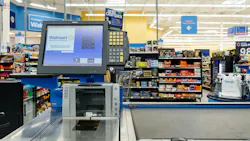
Large organizations can have many times this figure, and the US retail giant Walmart has announced it is rolling out e-labels to 2,300 of its stores. While the group hasn’t announced the number of labels per store, the UK chain Asda’s single-store trial had 25,000 e-labels, and US chains tend to be larger than their UK equivalents.
Batteries and Alternatives
Batteries have become the power source of choice for small IoT devices. While they can provide a convenient and economical solution, they also present operational challenges.
Monitoring the state of charge in vast numbers of batteries throughout a large building or in a factory can add a considerable management overhead. Replacing the batteries as they become discharged can be time-consuming, and staff may need to travel to reach devices installed in remote locations. The cost of replacement batteries, when added to the labor costs needed to monitor and change them, can be higher than the purchase price of the original device.
For consumer smart-home devices, where just a few are being implemented, charging via a 5V USB cable might be possible. But the 23,000-device supermarket example demonstrates exactly why this is impractical in a business setting.
Adding to the issues faced, flat batteries can also require the device to be reset once power is returned.
In addition, the problem of battery waste is attracting the attention of legislators. Regulation is already in force worldwide to govern battery composition and encourage recycling over disposal, and new research is now focusing on battery-powered IoT devices. The EU’s EnABLES project has suggested that batteries ought to last longer than the IoT devices they power. IoT-device OEMs and end users should take note and act to reduce the number of batteries entering landfill, or risk stringent recommendations becoming enforced through legislation. EnABLES has also highlighted the importance of energy harvesting as an alternative to battery power.
Energy Harvesting
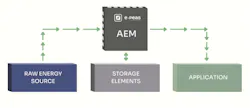
Energy harvesting captures energy from the ambient environment to convert into electrical energy. Ambient energy is present in various forms including light, heat, and kinetic energy from sources such as the movement of machinery or human activity. The main building blocks of a harvesting system include a converter such as an array of photovoltaic cells, power-management circuitry, and energy storage.
The converter transforms ambient energy into electrical power. At the core of the system, the power management block includes circuitry that conditions, stabilizes, and regulates the voltage to a level suitable for the device’s electronics. To compensate for the variability of the ambient energy source, an energy storage element ensures that power is available to meet the system’s demands whenever needed.
The optimal energy source depends on both the device’s power requirements and the type of ambient energy available. In most smart building applications, photovoltaic arrays (capable of harvesting energy from both natural and artificial light) are typically the most effective solution. However, other ambient IoT systems may benefit from alternative harvesting technologies, such as piezoelectric converters, which capture energy from vibrations, or thermoelectric modules, which exploit temperature differences.
Considerations for Eliminating Batteries
Whether it’s a thermostat, an e-label, a door lock, or a smart bandage for patient monitoring, a “typical” IoT device will have a basic design that is built around a sensor or actuator. This is linked to a low-power processor, wireless data transmission, and a small number of other components such as for security. And, of course, there is also a power source.
Because smart building IoT devices need to run on a single battery for several months or even years, their components have been optimized for ultra-low-power operation. This makes them exceptionally well suited to being powered from harvested energy.
Switching from battery-powered to energy harvesting requires the harvester itself, a power management chip (PMIC), and energy storage. Depending on the application, these can be particularly small. For example, a temperature monitoring system for a smart building HVAC controller could be built on a credit card-sized format using a 0.2 g/0.15 mm thick solar array coupled with a half-millimeter thick rechargeable battery.
For some IoT systems, it is also possible to bring in a second energy source.
As a result, the vast majority of smart-building IoT systems can be switched to become ambient IoT devices, with like-for-like functionality to enable a gradual, low-cost rollout as older devices need to be replaced or their batteries changed.
Energy harvesting can also be applied to other low-power non-smart-building IoT systems, and many such systems have been developed—for example, smart bandages to monitor or even improve the healing process.
Of course, energy harvesting is typically appropriate for systems with average power consumption in the order of microwatts or milliwatts, but even several watts is possible. The key evaluation metric, therefore, is watts × time. High average power loads usually cannot be supported, and so before making a switch, the first step should be to identify what power sources are available and how much these generate. For this, a wide range of low-cost tools are available.
Regulations should also be checked, as there will be regional or application-specific requirements preventing IoT systems from relying solely on batteries.
Today, the majority of IoT systems are based on disposable batteries. This is for historic reasons that simply no longer exist, and their continued use is proving highly costly for operators of smart buildings. And while AC charging exists for consumer systems, where just a few will be in use, this is not practical for B2B smart-building IoT applications.
We’re now at the point where the reducing cost and improved performance of energy harvesting systems means smart building operators can begin the process of switching. Doing so will not only improve facilities’ environmental credentials, but also significantly reduce the operational expense related to swapping batteries. A good example of this is asset trackers powered by indoor lights.
It is therefore no surprise that the number of manufacturers supplying ambient IoT equipment has grown significantly, with the majority of commonly implemented functions available as easy-to-swap-in devices. These are also available from multiple manufacturers.
Of course, there will be individual applications where there is no off-the-shelf energy-harvesting alternative currently available. For these, evaluation and development kits exist that can help develop customized solutions; similarly, there are many ambient IoT system developers that can create tailored systems.
Conclusion
The majority of IoT systems today rely on disposable batteries, creating operational and environmental challenges. Energy harvesting provides a viable alternative that can reduce costs, minimize waste, and improve reliability. With regulations and sustainability goals driving adoption, energy harvesting is positioned to become a central enabler of smarter, greener buildings.
About the Author
Christian Ferrier
Christian Ferrier is Chief Marketing Officer at e-peas, a pioneering semiconductor company specializing in energy harvesting solutions for the IoT. He brings over 12 years of experience at Semtech, where his last position was Worldwide Product Marketing Director of the LoRa 2.4GHz product line and Director of the global EDA organization. Prior to Semtech, he was the founder and CEO of Nexlink SA, an IT and hosted services company.
Christian is well-versed in both the business and technical dimensions of the IT and IoT marketplace, with a strong track record of building strategic partnerships with successful outcomes. He holds an engineering degree from EIVD (CH), an EMBA from HEG ARC University of Applied Sciences, and a Certificate of Advanced Studies in company management, all completed by 2014. He is based in the Neuchâtel region of Switzerland.