Beyond Rugged: Choosing Reliable Radios for Building Operations
Key Highlights
1. Reliable building communication starts by matching two-way radios to real operating conditions—not marketing labels.
2. Physical durability and environmental resilience provide a practical framework for evaluating industrial two-way radios.
3. RETEVIS RB48D combines rugged construction with DMR communication for demanding building operations.
Beyond Rugged: Choosing Reliable Radios for Building Operations
For facility managers, communication happens everywhere.
A maintenance technician may be inspecting equipment in a mechanical room while another team member responds to an issue several floors away. Engineering staff may move between loading areas, rooftops, parking facilities and utility spaces. Housekeeping, security and operations teams may all need to coordinate without stopping work to find one another.
In these environments, two-way radios for facility management are more than convenient communication tools. They are part of the daily operating workflow.
But choosing the right radio can be difficult.
Terms such as “rugged,” “heavy-duty” and “industrial grade” appear frequently in product descriptions. The more useful question for building owners and facility managers is:
What does reliable actually mean in the environment where my team works?
For RETEVIS, 16 years of communication experience have led to a practical principle: reliability should be evaluated against real operating conditions and supported by evidence.
Start With the Building, Not the Radio
Commercial buildings create communication demands that are very different from open outdoor environments.
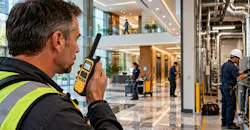
Maintenance teams may move between offices, stairwells, basements, mechanical rooms, loading docks and exterior service areas during the same shift. Concrete walls, equipment rooms and multiple floors can complicate communication.
The work itself also places demands on equipment.
A radio may be carried on a belt throughout an entire shift, handled while wearing gloves, exposed to dust or moisture, or dropped during maintenance work. Clear communication needs to continue while teams move between these environments.
That is why selecting industrial two way radios should start with several practical questions:
Where will the radio be used?
What physical and environmental conditions will it face?
What happens operationally if communication is interrupted?
What evidence supports the product’s reliability claims?
These questions shift purchasing decisions away from individual specifications and toward the needs of the building operation.
A Practical Way to Define “Industrial Grade”
For facility teams, “industrial grade” becomes more useful when reliability can be separated into measurable levels.
RETEVIS has developed a Three-Tier Industrial Reliability Standard to organize industrial communication requirements around increasing operating risk.
For many everyday commercial building and facility operations, the first two tiers provide an especially useful framework.
Tier 1: Physical Durability
The first level asks whether the radio can withstand the physical demands of everyday work.
Drops, vibration, repeated handling and impacts are common realities for maintenance and operations teams.
Instead of simply asking whether a radio looks rugged, buyers should look for supporting test evidence that demonstrates how the product performs under these conditions.
Tier 2: Environmental Resilience
The second level goes beyond physical durability.
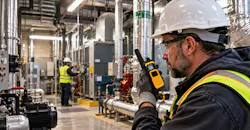
Facility teams may work in hot mechanical spaces, cold exterior areas, wet environments, dusty maintenance zones or locations where equipment experiences rapid changes in operating conditions.
Environmental resilience therefore considers factors such as temperature, moisture, dust and other conditions that can affect equipment reliability.
This distinction matters.
A radio can be physically strong without necessarily being designed for every operating environment. The goal is to match the level of protection to the actual conditions faced by the facility team.
Evidence Matters More Than the Label
A reliability framework only becomes useful when it is supported by evidence.
RETEVIS uses testing and product validation to connect the idea of “industrial grade” with measurable performance rather than relying on the term alone.
Testing conducted on products in the RETEVIS RB48 series references procedures from MIL-STD-810H:2019, covering areas such as temperature, rain, dust, drop, shock and vibration.
For facility managers, the important takeaway is not the military terminology itself.
It is the purchasing principle behind it:
Ask what has actually been tested.
That creates a more transparent way to compare rugged two-way radios and determine whether the equipment is appropriate for the operating environment.
RETEVIS RB48D Brings DMR to the Rugged Platform
The newest addition to the RETEVIS industrial radio lineup is RETEVIS RB48D, a DMR two-way radio developed around demanding professional communication environments.
RETEVIS RB48D builds on the rugged design approach of the RB48 series while adding digital communication capabilities for teams that need to manage day-to-day operations across commercial and industrial facilities.
For building operations teams, DMR can provide a structured path toward digital radio communication while supporting clearer organization of team communications.
But digital capability is only part of the purchasing decision.
The more important consideration is whether communication features and hardware durability work together for the environment where the radio will actually be used.
That is where the combination of DMR communication + Tier 2 environmental resilience becomes relevant for quality-focused facility teams.
Reliability Is Part of Building Operations
The value of reliable communication becomes clearer when viewed through the daily responsibilities of a facility team.
A technician waiting for clarification loses time. A supervisor walking several floors to locate another team member loses time. An unclear message during a maintenance response can create additional steps before the issue is resolved.
Reliable communication cannot eliminate every operational delay, but it can help teams coordinate without adding unnecessary friction.
This is especially important as facility departments are increasingly expected to maintain safe, reliable buildings while working with limited resources.
For building owners and facility managers, radio selection therefore should not begin with the longest specification sheet.
It should begin with the operating environment.
A Simple Checklist for Facility Managers
Before selecting a two-way radio system, ask four questions:
1. Where will our teams use it?
Map offices, mechanical rooms, loading areas, rooftops, parking structures and exterior spaces.
2. What conditions will the equipment face?
Consider drops, dust, moisture, temperature and daily handling.
3. What level of reliability does the operation require?
Different environments create different consequences when communication fails.
4. What evidence supports the reliability claim?
Look beyond words such as “rugged” and “industrial grade” to testing, protection levels and documented product performance.
The result is a more practical purchasing principle:
Choose the radio for the building—not the label on the box.
16 Years of Reliable Connections
As RETEVIS marks 16 years of communication development, reliability remains at the center of how the company approaches professional communication.
The technology will continue to evolve—from analog radios to DMR and from individual products to more complete communication solutions—but the fundamental question remains the same:
Can the people responsible for the operation stay connected when and where they need to?
For facility managers, answering that question starts with the building, the working environment and evidence that the communication equipment is ready for both.
RETEVIS will continue the conversation around reliable professional communication at PMRExpo 2026 in Cologne, Germany, November 24–26.
