How to Ensure Industrial Space Meets the Modern Needs of Small Businesses
Key Highlights
- Tenant satisfaction significantly influences lease renewals and recommendations, highlighting the importance of engagement across all industrial sectors.
- Neighborhood flex bay spaces provide operational flexibility, combining warehouse, office, and showroom functions within a community-compatible design.
- Demand for small-bay industrial spaces exceeds current supply, with a growing preference for adaptable, accessible environments close to workforce and customers.
- Design features like storefront glazing and pedestrian-friendly layouts enhance usability and community integration without compromising operational needs.
- In-place property management streamlines operations, reducing owner burdens and creating a reliable environment for tenant growth and efficiency.
Across commercial real estate, tenant engagement is increasingly shaping how properties compete and perform over time. Research published in 2024 by the MIT Center for Real Estate found that a one-point increase in a tenant's overall satisfaction is associated with an 8.6% higher likelihood of lease renewal and an 11.5% higher likelihood that the tenant would recommend the building to another business.
And although it’s often associated with office towers, hospitality environments, or experiential retail, industrial tenants—especially small and midsize businesses—require the same level of attention, responsiveness, and operational support as any other tenant base. It just looks a little different.
In industrial real estate, tenant engagement is expressed less through amenities and more through functionality, operational efficiency, and the ability of a building to support how businesses actually work day-to-day. And in today’s market, as operating conditions become more complex amid rising costs, staffing challenges, and economic uncertainty, many small and midsize businesses are seeking facilities that allow them to consolidate inventory storage, fulfillment, office operations, production, and customer interaction within a single location.
At the same time, communities and municipalities are placing greater emphasis on compatibility, design quality, and thoughtful land use integration.
These converging pressures are reshaping expectations around industrial development and driving demand for a more flexible approach to small-bay industrial space. One emerging response is the rise of neighborhood flex bay products, a growing niche within the broader small-bay industrial market designed specifically around usability, adaptability, and neighborhood-scale integration.
A Shift in Demand
Historically, industrial development prioritized large-format distribution, truck circulation, and centralized logistics infrastructure. While that model remains essential for regional supply chains, it does not always align with the operational needs of smaller businesses that rely on customer accessibility, workforce proximity, and operational flexibility.
Today’s small and midsize industrial users often require a hybrid environment that can combine warehouse, office, showroom, fulfillment, and customer-facing functions within one footprint. Contractors, service providers, light manufacturers, e-commerce operators, and specialty trades are among the businesses increasingly driving demand for this more flexible industrial format.
However, small-bay properties account for an estimated 29% to 36% of existing U.S. industrial inventory, depending on how the category is defined. Yet they represent less than 2% of the current construction pipeline and, by some estimates, as little as 0.3%.
According to Cushman & Wakefield, the vacancy rate for warehouses under 100,000 square feet was 3.9% in the fourth quarter of 2025, compared with 10.1% for warehouses larger than 100,000 square feet, further illustrating demand for smaller-format industrial space.
Designed Around Operational Flexibility
As demand continues shifting toward smaller, more adaptable industrial environments, developers are rethinking how industrial space can better support the day-to-day needs of modern businesses.
Neighborhood flex bay campuses sit between traditional industrial and commercial space, offering more functionality than retail and greater accessibility and visibility than large warehouse facilities. These campuses are purpose-built for businesses that want to operate, store, and serve customers all in one place.
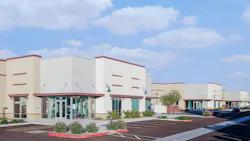
Buildings are typically divided into smaller bays that incorporate storefront-style entrances, integrated office or showroom space, grade-level roll-up doors and secured outdoor storage or work areas. This creates a more adaptable environment for businesses managing inventory, fulfillment, customer interaction, and administrative operations simultaneously.
This operational flexibility creates several advantages for tenants:
- Reduced need for multiple leases across retail, office, and warehouse properties
- Improved efficiency for businesses managing inventory, fulfillment, and customer interaction
- Faster occupancy timelines due to move-in-ready layouts
- Greater adaptability as operational needs evolve
- Improved proximity to workforce and customer bases
For many businesses, these efficiencies directly influence long-term occupancy decisions and operational scalability.
Closer to Rooftops, Customers and Workforce
Location is also becoming a more important factor in how small and midsize industrial businesses evaluate space. As metropolitan areas continue expanding outward, industrial uses are often pushed farther from population centers due to land pricing and zoning pressures. At the same time, many businesses benefit from remaining closer to rooftops, labor pools, and customers. This dynamic is contributing to growing interest in neighborhood flex bay developments positioned within infill and suburban corridors rather than isolated logistics districts.
Unlike conventional industrial projects that are often separated from surrounding commercial activity, neighborhood flex bay developments are intentionally designed to integrate more comfortably within mixed-use and suburban environments. Storefront glazing, pedestrian-scaled architectural elements, landscaped circulation areas, and screened service functions help create a more community-compatible industrial format while preserving operational functionality.
These design considerations are not simply aesthetic. They directly influence how tenants interact with customers, employees, and the surrounding community. For businesses that regularly receive clients, vendors, or customers on-site, professional storefront presentation and accessible layouts can improve day-to-day usability while integrated private yards, air conditioned warehouses, and service areas preserve the operational functionality required for industrial users.
In these environments, accessibility and visibility become operational advantages. Businesses can reduce travel times, improve service responsiveness, and maintain closer relationships with customers and employees. This balance between operational performance and architectural compatibility is becoming increasingly important as cities evaluate industrial projects through both economic-development and community-planning perspectives.
Streamlined for Ease of Operations
Finally, within neighborhood flex bay campuses, in-place property management can help simplify ownership and day-to-day operations through coordinated maintenance, responsive communication, and consistent site management. For tenants, that can create a more reliable operating environment that allows businesses to remain focused on day-to-day operations and long-term growth.
Conclusion
As industrial demand continues evolving, small and midsize businesses are placing greater value on flexibility, accessibility, and operational efficiency within the spaces they occupy.
Neighborhood flex bay developments are emerging in response to these changing expectations by combining industrial functionality with customer accessibility, thoughtful design, and environments that better support day-to-day business operations.
For many businesses, industrial space is no longer simply a place to store products or park equipment. It has become an extension of operations, customer experience, and long-term business growth. As a result, industrial environments that prioritize usability, adaptability, and tenant experience will likely continue playing an increasingly important role within the broader industrial market.
About the Author
Dale Cavan
Dale Cavan is the president of Cavan Commercial, a Scottsdale, Arizona-based real estate investment and development firm specializing in industrial and value-add opportunities across the Metro Phoenix region. With more than 30 years of experience, Cavan has built and led multiple successful real estate ventures, earning a reputation for disciplined investing, strong market intuition and a proven ability to execute through all phases of the economic cycle.