Lighting Upgrades That Support Long-Term Facility Resilience
Key Highlights
- Lighting upgrades can significantly reduce maintenance costs and operational disruptions, especially in high-ceiling spaces with difficult access.
- Retrofitting existing infrastructure with modern LED fixtures and plug-and-play adapters minimizes installation costs and preserves valuable building components.
- Accurate measurements, current drawings, and detailed planning are crucial to avoid costly errors during retrofit projects.
- Considering future reconfiguration and accessibility in lighting design enhances system longevity and ease of maintenance.
- Facility managers should treat lighting upgrades as lifecycle decisions, balancing energy performance with operational needs like access, maintenance, and adaptability.
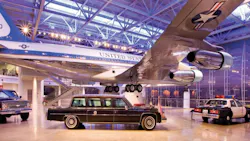
A lighting upgrade can solve more than an energy-efficiency problem. For facility teams, lighting technology also affects maintenance, access, downtime, labor, and a system’s ability to adapt to changing needs.
The Ronald Reagan Presidential Library’s Air Force One Pavilion operates its lighting nearly 24/7. Teams replaced an earlier generation of Lotus lamps mounted on suspended tracks after roughly seven years of constant use. The project retained viable infrastructure, addressed difficult-to-access fixtures, and improved illumination around the pavilion’s artifacts.
Designing for Difficult Access
The library’s pavilion serves as a museum and an event space. Fixtures are installed on ceiling-mounted tracks suspended up to 70 feet high.
John Lehne, building and facilities manager at The Ronald Reagan Presidential Foundation & Institute, said the previous Lotus lamps began to fail after seven years. Before the retrofit, the pavilion used 500W PAR 56 incandescent lamps to illuminate the space. Lehne said staff used lift equipment to replace lamps every two to three years.
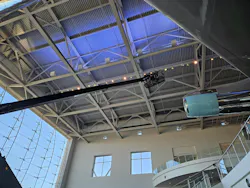
Due to the ceiling height, the team replaced all the Lotus lamps as part of a single lighting project to minimize repeated lift access and maintenance disruptions. The team replaced the 97 lamps in stages, allowing the team to manage the work while minimizing operational disruptions.
Consolidating work into a single project reduced the need for specialized equipment and labor to access the lighting. However, project cost, available capital, and operational constraints can require phased upgrades over multiple projects.
Based on the lamps’ service history, the changeout has nearly tripled the time between replacements.
“Longer-life LED bulbs greatly reduce maintenance costs, including rental equipment needed to access the track,” Lehne said.
An outside contractor and facility staff replaced the existing Lotus lamps mostly after hours because they could not safely perform high-elevation maintenance while the building was occupied.
Nathan Davis, public relations and marketing director for HyLite LED, shared that the team modernized the lighting without removing viable infrastructure.
Rather than undertaking a more extensive infrastructure overhaul, the retrofit used GX16D adapters to install the 97 new Lotus Lamps into the pavilion’s existing housing. The new fixtures retrofit gave the facilities team more flexible illumination for the aircraft and exhibits.
“To get the aesthetics right, they utilized the lamp's CCT selectable feature,” Davis added. “A crisp neutral white setting was chosen specifically to highlight the aircraft, bringing out the gleaming exterior details without casting harsh, unnatural hues."
Preserving functional lighting infrastructure reduced the construction’s scope and reinforced the importance of assessing existing conditions before selecting products. A useful specification process identifies components to retain, components to replace, and performance-limiting layouts
Retrofitting Around an Existing Layout
The pavilion required different approaches to illuminate aircraft and exhibits.
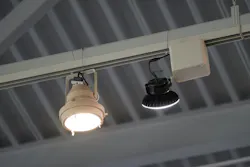
Davis said the retrofit let the team keep the existing fixture infrastructure and add standalone fixtures where the space needed more light to highlight the aircraft’s intricate details. Teams installed 95 40-degree and two 15-degree HyLite LED Lotus lamps.
“Utilizing a simple plug-and-play installation with GX16D adapters allowed the team to bypass the headaches and extended downtime of tearing out old infrastructure. This approach drastically lowered installation costs while still modernizing the space,” Davis said.
The Reagan Library project illustrates why facility managers should evaluate existing fixture locations, mounting infrastructure, access, and areas with inadequate illumination before selecting replacement equipment. A one-for-one replacement may not address every problem.
Evaluating the physical space is only part of the planning process. According to Dirk Zylstra, vice president of strategic innovation and product development for Axis Lighting, projects can go wrong when teams are working from inaccurate information.
A common problem he sees in retrofit projects is inaccurate information, where people work from bad drawings or bad information. Accurate measurements and current drawings give the same information to manufacturers, designers, contractors, and facility teams. He emphasized the importance of carefully reviewing shop drawings and submittals before manufacturing products.
Changes are relatively easy to make before production, but once equipment is manufactured and shipped to the jobsite, correcting errors can become significantly more difficult and disruptive. Attention to detail extends to maintenance, too. Zylstra said lighting specifications should consider the location and accessibility of drivers, which contain much of a fixture’s electronics.
“The easiest for maintenance is always having them in the actual fixture,” Zylstra said. “If it is a remote driver, I would think in terms of having them in a localized space so they’re easily addressable. That’s usually the component if there is ever a failure on a light fixture because it has most of the electronics in it.”
Digitally addressable control systems like DALI can also make lighting systems easier to reconfigure as spaces and lighting needs change, without requiring the same level of rewiring as some conventional control approaches.
For occupied facilities, Zylstra recommends breaking larger lighting upgrades into manageable areas. Teams can complete, test, and adjust the installation section by section. That approach lets facility teams identify problems before the system is completely installed and limits disruption.
“Close the little space down,” Zylstra said. “That’s really probably the easiest way to do it.”
Specification Decisions Become Maintenance Decisions
FMs should account for equipment access when specifying lighting. At the Reagan Library, Lehne said the fixtures’ settings remain unchanged during their usable life because accessing them is difficult and expensive. That makes initial decisions about color temperature, wattage, beam angle, and other adjustable features more consequential.
In facilities that require lift equipment and specialized access, FMs should consider how the lighting performs under expected operations—not only how it looks when installed. Choosing the right settings and configurations beforehand reduces the need for future adjustments that require additional labor, equipment, and downtime.
Looking Beyond the Product Swap
Upgrades to the Reagan Library pavilion lighting show the value of thoughtful building renovation and updates. The facilities team retained useful infrastructure, replaced aging components, added lighting flexibility where the previous system fell short, and considered future maintenance before installing new equipment.
Flexibility also influences how long a lighting system remains useful.
Zylstra said that when selecting lighting systems, consider potential future reconfiguration. Systems designed around fixed configuration may be difficult to update later, but reconfigurable systems allow lighting changes.
“If you plan and you discuss the choice of the lighting with the intention of reconfiguring, then that’s what makes it a lot easier,” he said.
Facilities teams should treat lighting upgrades as lifecycle decisions, not product swaps. While energy performance is a key factor in updating lighting systems, FMs must also consider access, maintenance labor, lift requirements, downtime, infrastructure compatibility, beam angles, and eventual replacement. Smart lighting upgrade strategies consider every stage, from specification to maintenance, helping FMs run operations that support long-term building performance and resilience.
The most resilient lighting upgrade isn't necessarily the most technologically sophisticated one. It's the one that solves the facility's current problems while making the system easier to operate, maintain, and adapt.
A resilient lighting upgrade is a lifecycle decision, not a product swap
4 stages of lighting
1. Before you specify: What should facility teams evaluate before choosing a retrofit, including existing infrastructure, access, and future needs?
2. During specification and design: How do you choose the right technology, controls, color temperature, beam spread, and mounting strategy?
3. During installation: How can teams minimize downtime, labor, infrastructure changes, and disruption?
4. After installation: How should the system be commissioned, documented, and maintained to maximize its useful life?
About the Author
 Lauren Brant
Buildings Editor
Lauren Brant is the editor of Buildings. She is an award-winning editor and reporter whose work appeared in daily and weekly newspapers. She strives to create content that is informative and actionable for professionals, helping them discover new products, technology, and insights to make smarter building decisions. In 2020, the weekly newspaper won the Rhoades Family Weekly Print Sweepstakes—the division winner across the state's weekly newspapers. Lauren was also awarded the top feature photo across Class A papers. She holds a B.A. in journalism and media communications from Colorado State University-Fort Collins and a M.S. in organizational management from Chadron State College.