Considerations for Commercial Solar (North Texas Facilities Expo 2026)
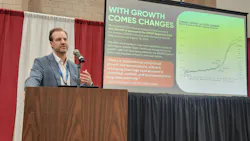
Energy costs have been rising due to an increase in power demand driven by growth in certain areas of the country, including the Dallas-Fort Worth area, explained Aaron Wilson, CEO of Solar One, at the 2026 North Texas Facilities Expo. The marketplace is highly dynamic—but with this chaos comes opportunity.
“Properly leveraged chaos can provide a lot of economic benefit and savings. It doesn’t have to be something negative,” Wilson said. “How do we plan? Are we planning right, or are we planning wrong? Are we sitting back and letting the market come to us, or are we meeting the market and using the market chaos to our advantage?”
Commercial building owners and operators can take the opportunity to control their energy costs by installing solar infrastructure, with or without battery storage, controls, and gas generator backups.
Design and Installation of Solar Arrays
The utility covering your area and your local rules and regulations will be a key deciding factor in how your solar array is designed, Wilson said. Your expected load and use case will come into play too, but rules and regulations are where to begin.
For example, if your utility doesn’t have net metering—the ability for you to send power back to the grid if you overproduce—you should seriously consider battery storage for your excess power, since you can’t sell the excess back to the utility. This is the case in Texas, where retail energy providers are not required by law to pay individual power generators back for their extra power, Wilson explained.
You’ll also want to understand what your building’s insurers want. Some rooftop solar systems are ballasted, meaning that weight holds the system in place. However, many insurers prefer to see mechanical attachments.
“There are good ways and bad ways to go about mechanical attachments,” Wilson said. “The key is that you want the attachment under your existing roof warranty, which means whoever holds the warranty needs to do the work on that scope.”
Types of Mounting for Solar Panels
There are plenty of options if rooftop solar isn’t an option for you. Ground-mounted systems don’t require disrupting your roof at all and can be designed with tracking so that they move to capture maximum sunlight throughout the day.
“Having a single-axis tracker is a great way to increase production, but now you have working parts,” Wilson said. “There are motors to track, there’s gears, there’s grease, there’s cabling. If you’re looking at a tracker vs. a fixed tilt, be aware that you may have some additional functions that are ongoing—maintenance, spare parts, and ensuring you have a tracker manufacturer who has a good track record of standing behind their work.”
Covered canopies over parking spaces are another option, but know that solar canopies by themselves aren’t watertight because the panels need to have a quarter-inch gap between them to prevent overheating—the canopies should have an EPDM gasket between the gaps to keep rain off of parked vehicles, Wilson said.
“All of these things can be done economically, but you just need to be prepared to ask the right questions and make sure you’re getting what you want at the end of the day,” Wilson said.
What to Watch For with Solar Panel System Design
Ask your solar installer about these considerations for your installation.
Existing underground utilities: “Think about the underground utilities between Point A and Point B,” Wilson said. “Maybe it’s too close to fiber or another feed. If you don’t have a good underground utility map or it’s not very accurate, be prepared for a ground-penetrating radar study.”
Special zoning considerations: “If you’re looking at putting solar on the ground or on a canopy, be aware to bake in time for getting zoning approvals you may need, a special use permit, or things of that nature,” Wilson said.
Addition of mechanical and civil trades to your electrical project: Canopy or ground mounts require the mechanical and civil trades to contribute. Make sure whoever you’re utilizing for the electrical installation respects those trades and has capability in them. For example, you may need to add concrete piers to the metal columns holding up your solar canopy if you’re in a location where salting is needed during the winter.
Impact and benefit to your on-site staff during construction and the long term: These systems are sophisticated, and there will be a lot of work happening to install them. Make sure the work is phased so that you’re not shutting down your entire parking lot for six months.
Geographical design considerations: Your location can influence your needs for the installation.
Budgetary accommodations: You may not expect to have to install things like concrete piers.
Utility regulations on your system rating: Your solar contractor may not be thinking through the lens of utility rules and additional requirements for systems above a certain size, Wilson said. Many utilities will require impact studies, supplemental reviews, or other documentation if your installation is above 1 MW AC.
About the Author
 Janelle Penny
Janelle Penny
Editor-in-Chief at BUILDINGS
Janelle Penny has been with BUILDINGS since 2010. She is a two-time FOLIO: Eddie award winner who aims to deliver practical, actionable content for building owners and facilities professionals.