7 Top Considerations for Lighting Control Projects (North Texas Facilities Expo 2026)
Key Highlights
- Implementing sensors, scheduling, and daylight harvesting can reduce lighting energy use by up to 60%.
- Power options include line voltage, low voltage, battery-operated, and kinetic, each with its own advantages and maintenance needs.
- Scalability is crucial; start with single-room controls and expand to entire floors or buildings as needed.
- Networked systems provide valuable data on energy use, asset tracking, and space utilization, supporting operational and ESG goals.
- Partner with reputable manufacturers with proven longevity and support to ensure system reliability and warranty coverage.
Today’s sophisticated lighting controls promise not just energy savings, but features like the ability to monitor occupancy or adjust HVAC based on data your lighting system collects. When upgrading your lighting control system, it’s crucial to understand what’s out there and how it can work for you.
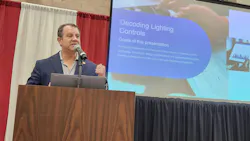
At the 2026 North Texas Facilities Expo, Frank Agraz, Corporate | ESCO Solutions Leader for Facility Solutions Group (FSG), explained what facilities teams and building owners must consider when it’s time to specify lighting controls.
How Lighting Controls Save Energy
Agraz explained two ways to lower lighting-related energy consumption: reducing the time the lights are on and reducing the wattage needed to operate lighting. Within these two broad categories are six strategies:
Hours of operation:
- Sensors automatically turn the lights on and off, adding convenience for your building occupants and preventing energy waste.
- Scheduling ensures lights are off during non-work hours, which reduces energy waste. Scheduling can also be used for security purposes, such as keeping lights on at night in specific areas.
- Plug load control reduces phantom loads by automatically turning off devices after people leave the space.
Wattage reduction:
- Task tuning reduces energy consumption by avoiding over-lighting. Allowing individuals control over lighting levels also enhances comfort.
- Daylight harvesting utilizes natural daylight to reduce a space’s reliance on artificial lighting. It reduces energy consumption and can also improve occupants’ moods and productivity.
- Demand response integrates the lighting system with your utility’s demand response program, allowing adjustments to lighting levels during peak hours to reduce costs and support grid stability.
The six strategies together are “a good recipe for saving up to 60% of your existing load,” Agraz said.
Design Considerations for Lighting Controls
As you compare lighting control products, there are seven major areas of options to consider, each of which will affect the cost, complexity, and usefulness of your project.
1. Functionality
Sensors, scheduling, and switches can all turn lighting in a space or zone on and off, but you’ll want to think about where to deploy each type. Sensors will adjust based on either motion detection or ambient light levels, depending on your needs in each space. Schedules may be timer-controlled, such as a switch or time clock; a cloud-based app; or your building management system.
You can also install a simple switch—this could be a simple on-off switch, a switch at the breaker, or even a preset scene selector, Agraz said.
2. Adjustment
Dimming reduces the lumen output of your lighting system and the power it consumes. Some lighting products will also let you adjust the color temperature (as in tunable white systems) or the color. Think about whether you need simple on-off adjustment, dimming, color-changing, or a combination of all three as you compare products.
3. Connection
Wired lighting controls are typically considered more reliable because the control signals are transferred through physical connections, Agraz explained. However, retrofitting wired systems is more expensive because of the additional material and labor involved. Wireless systems are faster and easier to install, which makes them ideal for retrofitting existing buildings; they use a wireless protocol that enables the controls device to communicate with the fixtures in the room or space.
Wireless controls also offer the opportunity to regroup or rezone fixtures regardless of how they’re wired, Agraz explained.
4. Power
You have four main options for powering your controls, Agraz said:
- Line voltage lighting controls handle incoming power directly from the electric panel and are typically either 120V or 277V. They usually cost less upfront than low voltage controls and can handle heavy loads.
- Low voltage controls operate at 12V or 24V and need a step-down transformer. These are considered safer and are easy to move.
- Battery-operated devices can be installed without the need for a dedicated incoming power infrastructure. They offer the lowest initial cost and are portable, but also have higher maintenance needs when it’s time to change batteries.
- Kinetic devices create power by harvesting energy when you press the button.
5. Protocol
Wired and wireless systems use different methods of communicating with each other, Agraz said.
On the wired side, you’ve probably heard of 0-10V dimming. This is an analog strategy, meaning the communication only flows one way—toward the driver. “There’s no information coming back,” Agraz explained.
By contrast, Digital Addressable Lighting Interface (DALI) is a two-way wired system. You can send dimming or other signals to the driver, and the driver can report back about things like its voltage or whether a fixture has burned out. DMX is another digital interface that’s common in theatrical and architectural lighting.
Wireless protocol examples include Bluetooth mesh, Zigbee, Z-Wave, and Wi-Fi. Each has trade-offs around range, bandwidth, battery life for battery-powered devices, and interoperability with other systems. Bluetooth Low Energy (BLE) has a significant advantage in this arena because nearly every smartphone, tablet, and modern laptop is BLE-compatible, Agraz said.
“Communicating wirelessly has come a long way, and there are a lot of features in today’s control environment that did not exist years ago,” Agraz added.
6. Scalability
As you look at lighting control products, you’ll want to think about your future needs. You can start in a single space, but will your controls be able to expand to the rest of the floor, multiple floors, or even multiple buildings?
Standalone controls offer single-room lighting control. They’re cost-effective and easy to scale, but because they’re not connected to the internet or controlled by your building management system, you can’t gather much data (if any) with them.
Networked lighting controls connect devices across multiple rooms, floors, or buildings and provide sophisticated analytics and monitoring capabilities.
7. Tracking
Networked lighting systems can report back to you about trends, monitor crucial systems, and offer insight on how to maximize efficiency, Agraz said. This can allow you to track information that might have been harder to collect before, including:
- Energy management: Where is your lighting used, and how much of it is being used? This can also help with ESG reporting.
- Asset tracking: Some lighting systems can sense asset tags attached to medical equipment, forklifts, and more.
- Space utilization: Motion sensors in the lighting system can help you see which spaces are used and by how many people.
Whatever your needs are, it’s important to partner with the right manufacturer. Many of yesterday’s big names are no longer selling lighting products. What happens to your support if your lighting manufacturer goes out of business?
“Work with subject matter experts to pick the right horse,” Agraz advised. “If the warranty that the controls provider is offering is longer than they’ve been in business, that’s not a good sign. Pick carefully.”
About the Author
 Janelle Penny
Janelle Penny
Editor-in-Chief at BUILDINGS
Janelle Penny has been with BUILDINGS since 2010. She is a two-time FOLIO: Eddie award winner who aims to deliver practical, actionable content for building owners and facilities professionals.