How to Build the Business Case for Building Decarbonization
Key Highlights
- Benchmark energy use, utility costs, equipment condition, and maintenance needs to identify performance gaps and establish a baseline.
- Use low-cost operational changes to reduce waste while planning larger capital projects.
- Coordinate equipment replacements with decarbonization goals, infrastructure needs, and available capital.
- Compare total ownership costs, including energy savings, incentives, maintenance, and required electrical or mechanical upgrades.
- Consider financing options such as utility incentives, grants, C-PACE, and energy performance contracts.

Decarbonization can compete with more pressing building and capital needs. Aging systems, electrical upgrades, and lower-carbon technologies can require significant upfront investment, while returns vary by building and location. Owners and facility managers need a property-specific plan to prioritize where to invest first and how to demonstrate the value.
The Pittsburgh 2030 District, a Green Building Alliance (GBA) initiative, offers one example of decarbonization’s potential impact. According to its 2025 Progress Report, participating properties achieved a 27.3% reduction in energy use and a 56.1% reduction in carbon emissions compared with baseline levels. Reported energy utility savings reached $42.8 million, while water savings totaled $7.1 million. Emissions reduction encompasses renewable energy purchases or production, energy-use reductions, and a cleaner electricity grid.
“One of the most important strategies contributing to the Pittsburgh 2030 District's success has been helping building owners move beyond individual energy efficiency improvements toward more comprehensive, long-term approaches to building performance and decarbonization,” said Chris Cieslak, Chief Operating Officer and Vice President of Programs, GBA.
Building owners are challenged with translating these results into a property-specific plan: identify performance gaps, prioritize investments, and connect projects to long-term operating and financial goals.
“Building Performance Standards (BPS) set clear outcomes for owners to improve their operations, upgrade their equipment, and electrify their buildings over time, but they also help local governments reduce the strain on the grid, lower utility costs, reduce outage risk, and improve community resilience," said Cieslak.

Begin with Building Performance
Utility bills, energy-use data, equipment condition, and maintenance records help owners pinpoint inefficiencies and set a baseline. GBA benchmarks the Pittsburgh 2030 District buildings against national data and a local cohort by property type, then provides partners with confidential annual performance reports and improvement recommendations to help owners assess opportunities from low-cost operational adjustments to major capital projects.
At Pittsburgh’s David L. Lawrence Convention Center, the team adjusted building automation settings, equipment controls, and operating setpoints, reducing unnecessary energy use with a near-immediate financial payback. It earned a LEED Gold certification in 2003, upgraded to LEED Platinum in 2012, and was recertified LEED Gold in 2023.
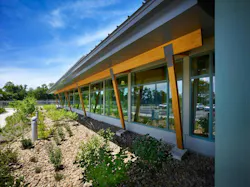
The $3.2 million Borough of Forest Hills project in Pennsylvania developed a retrofit strategy for seven existing municipal buildings to incorporate electrification, LED lighting, additional insulation, window replacements, roof upgrades, and routine equipment work. The projected reduction in annual energy consumption was roughly 243,000 kWh and 79% lower annual utility cost of approximately $92,000, compared with the baseline.

Build a Replacement Cycle Road Map
Equipment failures and scheduled replacements offer opportunities to improve efficiency and reduce emissions, instead of waiting for a building-wide retrofit. Rhea-Anne Pendley, senior product manager of commercial water heating at Lochinvar, encourages facility managers to evaluate existing systems and plan for future equipment needs before an emergency occurs.
“Facility managers should use this time to proactively audit their mechanical rooms and future equipment needs to avoid emergency replacements that often result in like-for-like and instead create a road map toward lower carbon emissions,” she said.
Ryan Schewe, product manager of commercial heat pumps and storage tanks at A. O. Smith, agrees that proactive planning is critical, especially with higher-efficiency equipment changing requirements for water heating installations.
"Nobody thinks about what type of water heater they have until they don't have hot water," Schewe said. "And now it's a five-alarm fire, an emergency, and it needs to be replaced now."
Urgent situations complicate decarbonization decisions. Switching from a non-condensing gas water heater to a condensing model can require different venting options and consideration of the surrounding space. Heat pumps can also introduce further requirements related to electrical capacity, airflow, and installation conditions.
Rather than waiting for equipment failures, FMs should evaluate replacement options as systems age. Then teams can assess infrastructure requirements, compare technologies, and determine how replacements fit into broader sustainability goals.
Hybrid systems that combine gas and electric technologies, including heat pumps, are potential bridges for owners who are not prepared to fully transition to electric equipment immediately, Pendley shared. The path to decarbonization is not linear. Teams must establish a plan that accounts for current conditions, future requirements, and available capital to guide each equipment replacement or infrastructure project.
Building owners use heat pumps as preheating equipment for existing gas water heaters, improving system efficiency while retaining conventional equipment to meet additional demand, Schewe shared. A phased approach allows a building system to reduce its reliance on fossil fuels while avoiding the cost and disruption of a single, building-wide conversion.
Decarbonization requires owners to compare projected energy savings, available utility rebates or incentives, maintenance requirements, and infrastructure upgrades. Collaboration with local utility companies can help owners strategize regionally relevant savings estimates since energy costs vary by location.
More Than Equipment
Equipment can trigger broader infrastructure needs. High-efficiency condensing systems may require specialized venting and additional drainage, while electrification may require electrical upgrades. Owners must evaluate the total cost of ownership, including equipment costs, projected energy savings, available incentives, and maintenance.
“Facility managers need to look at it as a systems-based approach,” Pendley explained. “The value extends beyond the product itself. When evaluating a project, they should consider the total cost of operations, including the energy savings that they can glean from the high efficiency; utility rebates; tax incentives, in some cases; and reduced maintenance costs with the new equipment that can factor into the total evaluation and overal financial assessment.”
Schewe recommends taking the system-wide perspective further by evaluating the building's demand before selecting replacement equipment. Water heaters are sometimes changed due to the capacity of the current equipment, although building conditions may have changed. Decades-old plumbing fixtures may move a higher flow rate than today's fixtures, so a building may not need the same water heating capacity it did originally. FMs should assess current hot water demand, existing fixtures, equipment sizing, and available infrastructure before specifying replacements. Right-sizing equipment helps avoid unnecessary capital expenditures while supporting building performance.
Unlike conventional gas equipment, heat pumps use nearby air to transfer heat, meaning room temperature, airflow, and space must be considered. Outdoor installations require attention to ambient temperature and freeze protection.
Schewe explained that heat pump water heating technology has been used for decades and products are available for below-freezing temperatures. A heat pump with a coefficient of performance (COP) of three or four can deliver roughly three to four units of heat for each unit of electricity consumed, although actual performance depends on operating conditions.
"Let's take a step back. Let's look at this from a bigger picture," he said. "Let's look at what you actually have, not just pulling out one and putting one in that does the same performance."
Explore Financial Options
Owners should look at utility incentives, grants, applicable tax incentives, Commercial Property Assessed Clean Energy (C-PACE) financing, and energy performance contracts to fund eligible upgrades.
“C-PACE can provide up to 100% funding for energy efficiency, renewable energy, water conservation, resiliency, and indoor air quality projects by placing an assessment on the property to repay the cost of the upgrades over the life of the upgrade,” Cieslak explained. “This shifts both the risk of the investment and the reward of the project to the commercial asset itself, rather than being borne by the owner.”
The Oxford Development Company established a five-year capital improvement plan around mechanical system lifecycles at 411 Seventh Ave. in Pittsburgh, a 1916 office building. By 2021, the plan had reduced energy use by 62% compared to baseline.
At Two PPG Place, Highwoods Properties invested in chillers, heat recovery, controls, roofing, and lighting, improving energy performance from 7% below baseline in 2012 to 48% below baseline in 2021.
A strong business case links measurable performance data, project costs, financing options, and long-term asset needs. Decarbonization is an ongoing investment strategy, not a single project with a universal payback period.
“There's no one-size-fits-all approach,” said Cieslak. “Each building has unique operating conditions, infrastructure, equipment needs, financial constraints, and performance goals. We encourage building owners to consider long-term asset management rather than a series of isolated projects.”
About the Author
 Lauren Brant
Buildings Editor
Lauren Brant is the editor of Buildings. She is an award-winning editor and reporter whose work appeared in daily and weekly newspapers. She strives to create content that is informative and actionable for professionals, helping them discover new products, technology, and insights to make smarter building decisions. In 2020, the weekly newspaper won the Rhoades Family Weekly Print Sweepstakes—the division winner across the state's weekly newspapers. Lauren was also awarded the top feature photo across Class A papers. She holds a B.A. in journalism and media communications from Colorado State University-Fort Collins and a M.S. in organizational management from Chadron State College.
Related
 Efficiency First Hero
 Owned and operated by Hudson Square Properties—a joint venture of Hines, Trinity Church Wall Street, and Norges Bank Investment Management—345 Hudson occupies an entire city block between King and Charlton Streets and serves as a case study for low-carbon retrofits in the New York market.